Law faculty have 24-hour access to the collection with their campus ID card.
Administration
Circulation
Collection Maintenance
Public Services
Foreign, Comparative, and International Law Librarian
274C JRCB | 801.422.7472
Law faculty have 24-hour access to the collection with their campus ID card.
Library liaisons are assigned to each full-time law school faculty member. These liaisons act as intermediaries between the Law Library and the faculty. Liaisons meet with their assigned faculty regularly to determine individual library needs and research interests. They also ensure that faculty members are aware of library services and collections and seek suggestions regarding how library services can be improved. Library liaisons are available to assist faculty members with their research needs. They obtain library material for faculty members and arrange for other library services that are needed or requested.
Specific services might include:
| Curtis Anderson | Nick Hafen |
| Clark Asay | Shawn Nevers |
| Kif Augustine-Adams | Annalee Hickman Pierson |
| Shima Baradaran Baughman | Melanie Brown |
| Annika Boone Barkdull | Kristen Kellems |
| Ben Bates | Iantha Haight |
| Catherine Bramble | Annalee Hickman Pierson |
| Elizabeth Clark | Kristen Kellems |
| Will Clayton | Iantha Haight |
| Justin Collings | Shawn Nevers |
| Elysa Dishman | Iantha Haight |
| Dayle Elieson | Nick Hafen |
| John Fee | Shawn Nevers |
| Cliff Fleming | Annalee Hickman Pierson |
| Kelsey Flores | Melanie Brown |
| Kristin Gerdy Kyle | Annalee Hickman Pierson |
| Brook Gotberg | Iantha Haight |
| Lisa Grow | Shawn Nevers |
| Sarah Hamilton-Jiang | Melanie Brown |
| Matthew Jennejohn | Nick Hafen |
| Eric Jensen | Kristen Kellems |
| Cree Jones | Melanie Brown |
| Tom Lee | David Armond |
| Tyler Lindley | Kristen Kellems |
| Aaron Mahler | Melanie Brown |
| Jane Mitchell | Shawn Nevers |
| David Moore | Shawn Nevers |
| Carolina Núñez | Annalee Hickman Pierson |
| Stephanie Plamondon | Annalee Hickman Pierson |
| Bradley Rebeiro | Annalee Hickman Pierson |
| Brett Scharffs | Kristen Kellems |
| Gladriel Shobe | Shawn Nevers |
| Jarrod Shobe | Shawn Nevers |
| Gordon Smith | David Armond |
| Michalyn Steele | Annalee Hickman Pierson |
| Dane Thorley | Nick Hafen |
| Lucy Williams | Annalee Hickman Pierson |
| Kevin Worthen | Annalee Hickman Pierson |
| Charity Bunson Wyatt | Melanie Brown |
The Law Library employs law student reference assistants to assist law faculty with their research needs. These law students provide support for law faculty who either do not have enough ongoing work to justify hiring their own research assistants or need assistance beyond their own research assistants. The reference assistants are meant to complement, not replace, individual faculty research assistants. The reference assistants work primarily on research requests
In addition to providing research support to law school faculty, the reference assistants also provide reference services to library users virtually and in-person at the Law Library.
Data project support is a faculty service the Law Library provides to law faculty. The support is provided by data assistants (undergraduate BYU students), who collect data and/or enter data that does not require being a law student or having any legal knowledge or background. The data assistants also work on data projects supporting corpus linguistics. The data assistants are hired, trained, and managed by the Data Project Manager, Teresa Odam. Faculty requests for data project support may be made through library liaisons who will coordinate with the Data Project Manager to ensure the carrying out and completion of the requested data project.
The reference assistants will continue to provide support for data projects that require some legal knowledge or background learned through the first-year legal research and writing program in law school, though traditional research requests may receive
The Law Library faculty are available to work with and train law faculty research assistants in the process of legal research and to suggest research strategies for particular research projects. Contact your library liaison for individual training for your research assistant(s) any time through the year. General summer RA training takes place shortly after Winter semester. Contact Shawn Nevers for more information. Law Professors are also welcome to send their RAs to class sessions of Advanced Legal Research, scheduled during Winter semester. For the syllabus or more information, contact Shawn Nevers at (801) 422-8784 or neverss@law.byu.edu.
The Law Library subscribes to a growing number of electronic databases. A full list is available on the Law Library website. View the list of BYU Law Library databases here. Contact Melanie Brown at (801) 422-4071 or melanie.brown@law.byu.edu with questions about access and training. Contact your library liaison if you are unable to find a database that meets your research needs.
Law school faculty have special borrowing privileges at the Law Library. Regular library materials are due in May of each year and may be renewed as needed. Journals may be checked out for one month. Non-circulating and reserve materials may also be checked out by special arrangement. No overdue fines are charged to law faculty for regular Law Library material. However, all items are subject to recall by the Lee Library or other patrons. Be aware that any fines accrued due to the late return of a recalled item are non-waivable.
To request material from the collection, faculty members may contact either their liaison or Melanie Coleman at (801) 422-3656. Faculty may also come to the Circulation Desk on the second floor of the Library for assistance.
Interlibrary Loan is a FREE service that the Law Library provides through agreements with other libraries to expand the walls and provide access to a variety of materials that we may not have in our own collection.
ILL pulls materials first from the Law Library. If the material cannot be found here, then the search extends to the Lee Library and to other libraries after. It is rare for materials not to be available through this process. The library may purchase materials that are important to your research. Contact your library liaison about doing so.
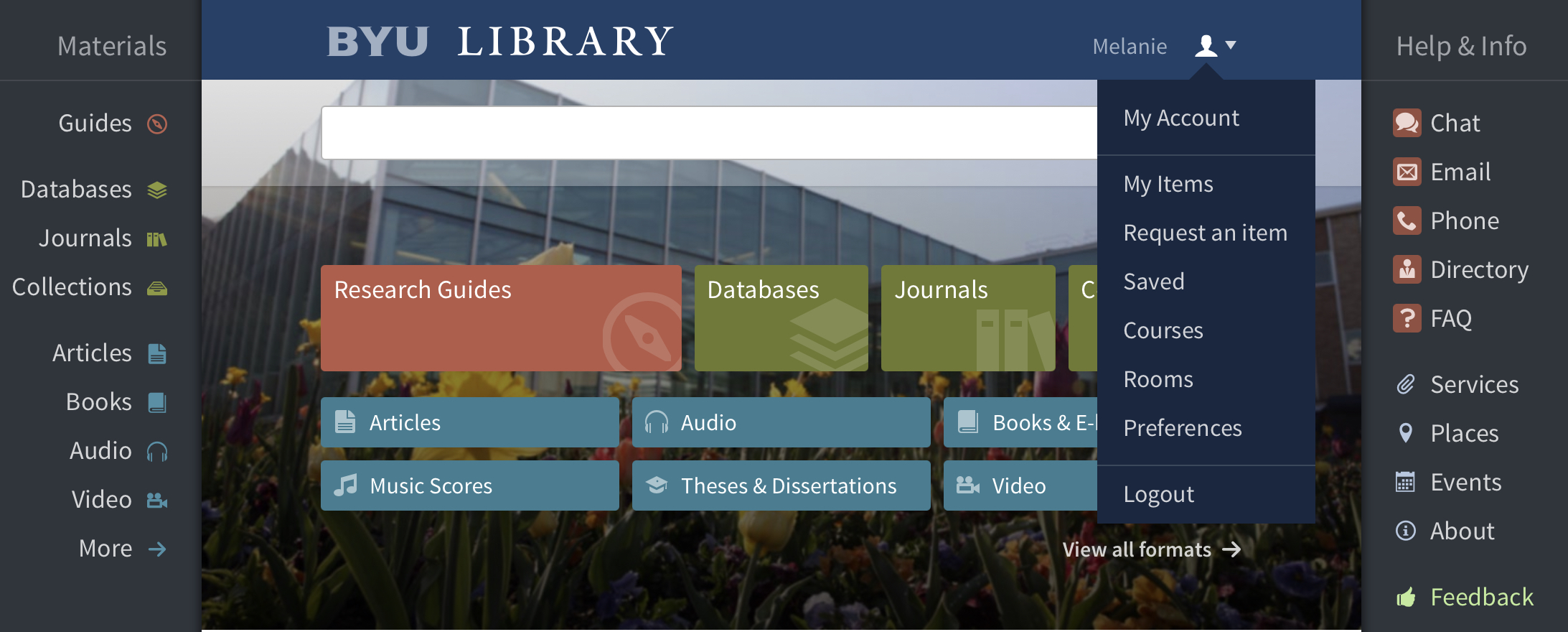
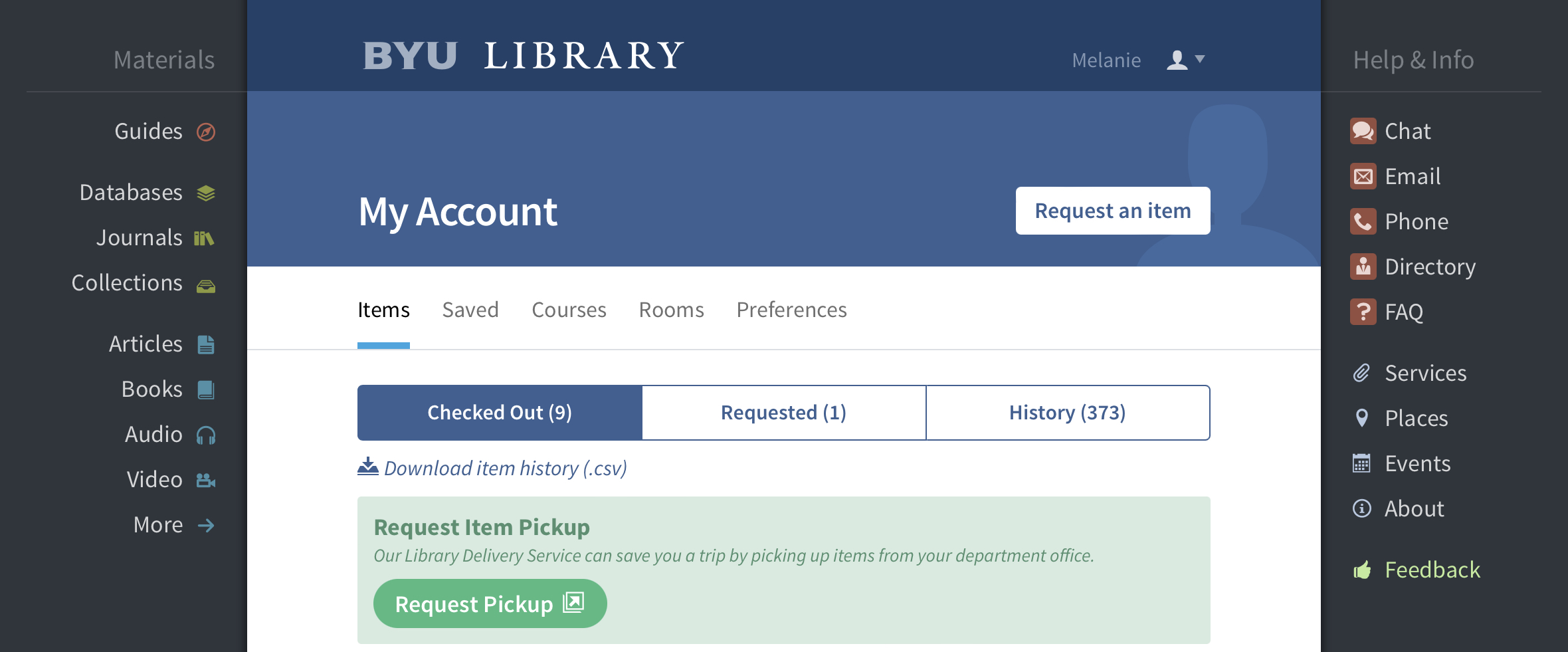
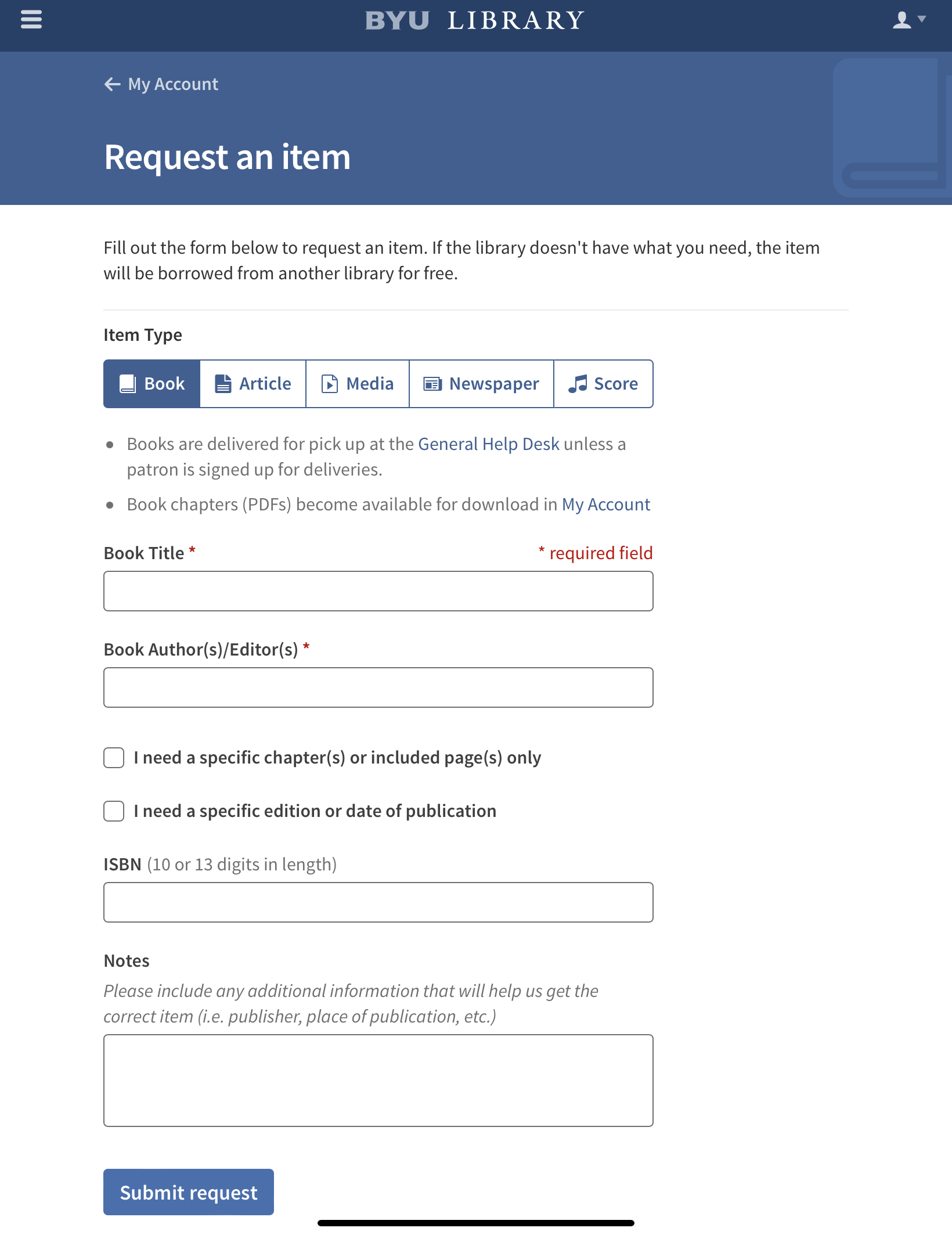
The Law Library will not request materials that are available from the Law Library or Lee Library. This includes items on course reserve and all other non-circulating items.
Set up an appointment with Melanie, she will be able to help you navigate through the ILL process and help you obtain the materials you need.
In most cases we are able to obtain the items you need, but occasionally some items cannot be sent physically. The Access Services Librarian will work with you to reach a solution. There are many other specific items that can be scanned and obtained rather than entire publications, textbooks, or print including
Melanie Coleman—Access Services Librarian
Email: colemanm@law.byu.edu
Phone: 801-422-3656
Due to past experience, our recommendation for law faculty when materials are needed from the Lee Library is to contact their Liaison, the BYU Law Library Reference Services, or Melanie Coleman; or to submit an online request through InterLibrary Loan (ILL). We have developed procedures to retrieve materials quickly and to automatically reroute requests to other libraries (ILL) if a requested item is not immediately available at the Lee Library.
However, if needed, law faculty may request proxy privileges for a secretary or a research assistant that allows the designated proxy to check out materials from the law library in the faculty member’s name. Research assistants should never be encouraged or required to use their personal accounts to borrow materials for faculty members.
Law Library proxy privileges should be requested through Melanie Coleman via email. The Harold B. Lee Library also provides proxy privileges according to their established policies.
Proxy privileges are not available for law students.
Faculty members are encouraged to recommend new titles for the Law Library collection. Please send requests to your library liaison. Requests for digital purchases and database licensing can be sent to Iantha Haight, haighti@law.byu.edu. We will route new print materials to your office if you wish.
The Law Library maintains several reserve collections, described below. Reserve collections may consist of both materials purchased by the Library and personal copies.
Course Reserve: The Law Library maintains a limited collection of print resources for use in supplementing course readings. These materials are available for limited two-hour checkout. We discourage students from relying exclusively on Course Reserves for access to casebooks because books are shared among multiple students and will be inaccessible if the student cannot come to campus (e.g., during an illness).
Electronic Course Reserve: In order to support learning on- and off-campus, the Law Library offers limited digital course reserves when requested by faculty and as licenses are available. Casebooks are not provided due to cost and licensing limitations. Electronic materials are usually provided via links on the course’s Canvas page.
Whenever possible, the Law Library is happy to assist faculty by licensing ebook versions of monographs or selections from books for course readings, or by locating unrestricted digital copies of monographs. Licensing options are controlled by the publisher and vary from unlimited access to use by one reader at a time. Some books are not available for any form of digital licensing.
Faculty are encouraged to contact the Law Library at least one month in advance of the start of the semester with a reading list to allow for time to obtain needed resources. Faculty may be provided with a URL to the ebook to make available to students on the course’s Canvas page. Copiers in the law school can also serve as scanners (please remember to include the title page and copyright statement from the source item with materials duplicated for academic purposes). Contact your library liaison (locating materials), Melanie Coleman (ILL & library materials), or Iantha Haight (ebook licensing) for additional assistance.
A/V Reserve: A/V reserve consists of audio/visual items, software, and similar material. These items are located behind the Circulation Desk and may only be borrowed for a limited time. Course reserve and professor files may be borrowed for 2 hours at a time. Audio/visual and software reserve items circulate for 24 hours.
Reserve Room: The Reserve Room is located on the second floor, in room 280 JRCB (near Circulation). The Reserve Room consists of high-use monographs (treatises, study aids, Nutshells, etc.), self-help materials (Nolo guides), six months-worth of newspapers (the Wall Street Journal, the Deseret News, the Salt Lake Tribune, the Daily Herald, the Intermountain Commercial Record), and the Utah law collection — including copies of the state code and Utah secondary sources. The Biblical Law and Benson Collections are also located in the Reserve Room.
Law Library faculty are available to come into law classes to teach students how to conduct legal research in specialized areas and demonstrate how to use specific library and research resources. Librarians can give students an overview of the Library’s print holdings and relevant electronic databases. This type of instruction can be very useful to students, especially in seminar courses where a paper is required. Requests for such lectures can be arranged through library liaisons.
Your.library liaison may be able to assist you in obtaining supplemental course materials. Please keep in mind that most librarians also have a teaching load, and plan accordingly.
We also now rely on campus resources for copyright support.
Members of the BYU community who make use of copyrighted works are responsible for ensuring compliance with all applicable copyright laws. In some cases, individuals may be required to determine whether a desired use qualifies for one or more exemptions set forth under copyright law, such as fair use.
https://policy.byu.edu/view/copyright-policy

The BYU CLO has posted the following guidelines for all supplemental course materials:
Links to supplemental resources are always the recommended option, because links do not involve making copies. Linkable resources include authoritative sites on the open web, LexisNexis, Westlaw, HeinOnline and other library-licensed material. The Law Commons is an open-source repository of scholarly legal content, including law review articles from many highly-ranked journals. The Library of Congress provides access to online federal legal resources, as well as links to state primary legal resources. Cornell’s Legal Information Institute is another good portal to legal resources and information. Google Scholar can be also be useful as a tool for locating authoritative legal content, including case opinions.
If the supplemental material to be shared with a class is not openly available online or included in a library subscription, you will likely need to obtain copyright permission for that use. Faculty always have the option to obtain clearance themselves, and then keep a record of that permission. This approach is often the best choice if the copyright owner of the desired content is a known colleague. A fillable PDF form letter is provided as a model, but a less-formal email is sufficient if it contains adequate detail.
Please contact your liaison or Annalee Hickman Pierson if you would like help with locating sources for supplemental course materials.
Questions regarding copyright issues and requests for clearance should be directed to the BYU Copyright Licensing Office.
The Law School is committed to the enforcement and protection of copyrights as both a legal and an ethical imperative. A copyright is a set of exclusive rights that vests in the author of an original work of authorship (including literary, musical, dramatic, pictorial, sculptural, and motion picture works). The copyright attaches upon the work’s creation (when it is “fixed in a tangible medium of expression”); current law does not require the formalities of registration or of a copyright notice such as the “©” symbol. The exclusive rights covered by copyright include the right to (1) copy or reproduce the work or portions of the work (including by making electronic copies); (2) prepare “derivative works” based on the original; (3) distribute copies of the work or portions of the work (including by electronic means); and (4) publicly perform or display the work.
Any faculty member, staff member, or student who intends to copy or distribute any material that is not in the public domain and is, therefore, protected by copyright must first receive copyright clearance from the law school’s Copyright Coordinator under the procedures set forth here, unless the copyright is held by that faculty member, staff member, or student. Copyright clearance is required even if the material is believed to be covered by the doctrine of fair use, and even if permission has already been secured from the holder of the copyright by the individual faculty member, staff member, or student. “Copying” and “distributing” include not only making and distributing hard copies, but also making any digital or electronic copies, posting such copies on the internet or the law school’s web page, or distributing copies via e-mail.
Any faculty member, staff member, or student seeking copyright clearance must contact the law school’s Copyright Coordinator. Requests for clearance should be submitted on a form approved by the Copyright Committee. The request should be submitted as far in advance of the use of the material as is reasonably possible (preferably at least one month in advance). The form for the written request may be completed in hard copy or on the law school’s web page, and will require the person submitting the request to (1) identify the copyrighted works in question by author, title, publication date, journal citation (where applicable), publisher (if known), and ISBN/ISSN (if known); (2) describe the nature of any copying and/or distribution (e.g., hard copies, scanning, uploading, etc.); (3) identify the name of the course and number of students to whom the material will be distributed; (4) indicate whether the person submitting the request has ever previously received permission to use the material in question, and attach any documents memorializing such permission; and (5) indicate whether the person submitting the request believes that a fair use privilege applies, and provide a brief justification for such privilege.
Many single copies made purely for research purposes will be covered by the doctrine of fair use, particularly where only a portion of the original work is copied. For such uses, the Copyright Coordinator may provide clearances that may cover certain uses, without requiring specific clearance requests for each individual copy.
If a faculty member disagrees with a decision of the Copyright Coordinator, appeal may be made to the Associate Dean for Faculty & Curriculum.
Thank-you for submitting this request. You should receive a confirmation email shortly.
Do you need permission to use additional resources?
Because keeping up with current events and scholarship is important for faculty research and writing, the Law Library provides a number of current awareness tools. This page summarizes some common current legal awareness resources. Most of these resources are also available to students and can be utilized in teaching. Contact your library liaison with questions or to develop a current awareness plan tailored to your needs.
The following electronic news websites are available through the Law Library. Contact Iantha Haight with access questions:
BYU Law faculty can subscribe to eJournals from SSRN’s Legal Scholarship Network (LSN) and the Entrepreneurship Research & Policy Network (ERPN) for the latest scholarship on topics of interest because the BYU Law Library is a subscribing institution. Contact your library liaison for help setting up your subscriptions, or follow the directions on SSRN’s website: https://www.ssrn.com/index.cfm/en/lsn/lsn-subscribe-orgs/.
You can modify your eJournal subscriptions through your SSRN account at any time. Contact your library liaison for assistance.
The Law Library can also assist with posting your scholarship to SSRN and including it in subject-matter eJournals. Contact your library liaison or Annalee Hickman Pierson, hickmana@law.byu.edu.
SmartCILP is a weekly email alert providing customized notifications of recently published law journal articles organized by topic, e.g. “Administrative Law” and links to the full-text publications on HeinOnline. Editors at the University of Washington’s Marian Gould Gallagher Law Library have been providing this service for over 80 years, and they currently index over 600 publications using 104 subject headings. To set up your SmartCILP research profile and begin receiving weekly SmartCILP notifications, contact your library liaison or click on the following link for instructions: https://help.heinonline.org/kb/creating-a-smartcilp-profile/.
You can change your profile as often as you like. Contact your library liaison or click on the following link for instructions: https://help.heinonline.org/kb/managing-your-own-smartcilp-profile/.
Many electronic resources have the option to create custom email alerts that can notify you when new legislation is proposed, new citations are available for a case or an article, or can run a set keyword search periodically and email you the results. For assistance, contact your library liaison.
The Law Library receives print copies of several national, local, and legal newspapers. The most current papers are available in the commons area near 484 JRCB. Older papers are stored in the Reserve Room for six months, after which they are discarded. For assistance with locating a newspaper article, contact your library liaison.
American Bar Association Affiliated Upcoming Events
SSRN Legal Scholarship Network’s Professional Announcements
Scholastica — contact Shawn Nevers for help setting up an account
Information for Submitting Articles to Law Reviews & Journals
Writing for and Publishing in Law Reviews (By Mary Whisner & Ann Hemmens, University of Washington Law Library)
Resources for Keeping Up and Staying Current (By Mary Whisner, Stacy Etheredge, & Cheryl Nyberg, University of Washington Law Library)
Law faculty can receive notifications when their articles are cited by signing up for various citation alert services.
HeinOnline
On HeinOnline, faculty can sign up for email alerts in their HeinOnline author profile page for whenever their articles on Hein are cited by new publications and cases on Hein. View instructions on how to manage author alerts from HeinOnline here: https://help.heinonline.org/kb/how-to-manage-author-alerts/.
Google Scholar
You can make a Google Scholar profile and receive alerts any time your articles on Google Scholar are cited by other works in Google Scholar. You can read more about Google Scholar profiles and how to receive alerts here: https://scholar.google.com/intl/en/scholar/citations.html#citations. If you need help making your Google Scholar profile, see the screencast made by the BYU Law Library here: http://huntersquery.byu.edu/google-scholar-profiles/.
Contact your library liaison for any assistance you may need.
Law students may access library resources during regular hours. Law students also have 24-hour access to the J. Reuben Clark Building with their campus ID card, and may enter the library after the outer building doors are locked at 10pm. ID card access is governed by the Law School Security Policy.
The Howard W. Hunter Law Library is open to the general public until 6 pm Monday through Saturday (excluding holidays). The Howard W. Hunter Law Library provides restricted access to current law students as described by this policy. The University has installed a swipe card security system that is designed to restrict access to current law students and approved patrons after 6 pm.
All students have access to the Howard W. Hunter Law Library during business hours. To help maintain the environment of the library, the law library will restrict access after 6 pm to current law students who have signed the Restricted Access Building policy.
After 6pm, entering and exiting the library is restricted to the second floor. To enter the library, students will need to use their BYU ID on the badge reader located by the east entrance of the library.
For access related issues or questions, please contact Melanie Chao.
Failure to abide by this policy may lead to a loss of restricted access privileges as well as Law School and University disciplinary action.
As a courtesy, the Law Library provides study carrels to all current law students in good standing. First-year law students are randomly assigned carrels in the “1L area” at the beginning of the school year. Second- and third-, and fourth-year students select their carrels in April for the upcoming school year. Selection order is determined by a randomly generated lottery system. Incoming second-, third-, and fourth-year students who do not select their carrel during the selection period are not guaranteed carrels outside of the “1L area”. Switching carrel locations is not allowed unless approved by Student Services.
All law students are expected to abide by the terms of the “Carrel Occupancy Agreement.” (pdf version), including the Carrel Use Policy. (Repeated failure to abide by the terms of the Agreement may result in the loss of carrel privileges. It may also result in the denial of carrel privileges in future years.) Each carrel has locking cabinets and file drawers and is provided with power and data outlets. Carrel problems should be reported online or to the Circulation Desk.
Note: Room 388 has been designated as a study room. This room does not have a speaker installed. With the door closed, the occupants may not hear library or building announcements.
For questions about the study room policy or to report monopolization of a study room, contact the SBA by sending a message to “sbaweb@law.byu.edu.”
For concerns about how the program is functioning, please contact Melanie Chao through email.
| Circulation: | 801-422-3593 |
| Reference: | 801-422-6658 |
There are 15 study rooms and 2 Zoom booths in the Law Library, designated exclusively for Law School use.
The study rooms may be reserved for two consecutive hours by groups of two or more law students. Study groups may sign up for only two 2-hour blocks in a given room each day. Groups must occupy a room within 15 minutes of their scheduled reservation, or lose their reservation for that hour. Unoccupied study rooms are available on a first-come-first-served basis to any group of two or more law students. No food or drink is allowed in any study room.
For tips on study groups (including best practices, study group activities, and study group technology tools), see the Student Groups for Law Students research guide.
For personal study, consider instead the Quiet Study Room on the second floor.
Zoom booths may be reserved for up to one hour and can be used for interviews, personal phone calls, and appointments. These booths should not be used as personal study rooms. No food or drink is allowed in any of the Zoom booths.
The Quiet Study Room is located in the northeast corner of the law library’s main floor next to the Innovation Space (Room 271) and the Library Training Classroom (Room 267). This room is only available to law students and must be accessed with the student’s ID card. The room will accommodate up to fifty students and includes soft couches and chairs, carrels, and tables. Law students using the space must refrain from phone calls, group study, and noise that could disturb others using the space.
The Rex E. Lee Room (393 JRCB) is a great place to take a break, relax, and socialize with friends and family members. The room has both work tables and soft seating, and lots of natural light for chasing away the winter blues. Shelves hold a collection of popular novels and magazines for law students, as well as a selection of games and puzzles. Law students are welcome to bring their children to this room. It has a kids’ corner with some toys and books for young children.
The Library Innovation Space (Room 271) is located on the Law Library’s main floor. The room has moveable furniture including work tables and whiteboards, allowing for numerous configurations that facilitate breakout sessions, group work, and design-thinking exercises. Due to its flexible nature, the space is a popular classroom and hosts everything from large lecture courses, to small seminars, to BYU’s Legal Design Clinic, Law X. Guest lectures and training classes for the Law Library’s Legal Tech Initiative are also frequently hosted in this space.
The Library Instruction Room (Room 267) is located on the main floor of the Law Library near the Innovation Space (Room 271) and the restrooms. Designed to facilitate instruction in electronic legal research skills, this room is equipped with a projection screen and eight monitors along the sides of the room. This room hosts first-year legal research and writing courses, advanced legal research, library research workshops, and other Law School classes.
The Law Library 1st Floor is the basement level of the library. It houses a number of research materials, including the Law and Religion Studies collection, government documents, law reviews and journals, microfiche, state reports, and archived state codes. The 1st Floor is also home to 76 study carrels that can be selected by rising 2L and 3L students during the spring carrel lottery. The 1st Floor is an excellent carrel space for students who prefer a quieter study area.
Registration information for Lexis+, Westlaw, and Bloomberg Law accounts are sent to all incoming 1L and LLM students in August shortly before the beginning of the fall semester. New students should register for these accounts promptly so they can complete assignments for their legal research and writing classes. Transfer and visiting students will receive registration information early in the semester they begin study at BYU Law School.
Students who graduate from law school later than they originally planned due to personal reasons or the completion of a master’s degree will likely experience expired research accounts. Students who experience any trouble with their legal research accounts, including new registration difficulties or account expiration, should contact Melanie Brown for assistance.
Students are encouraged to use their legal research accounts throughout their education at BYU Law School, including during the summer. Students should note, however, that Westlaw accounts may not be used for paid law firm or corporate work.
BYU Law Library sometimes licenses e-books assigned for Law School courses (not casebooks or textbooks). Links to these e-books will be provided on the course Canvas page. Access may be limited, so please be courteous to other students and checkout books only while you are reading them. Email Melanie Brown if you hare having trouble accessing an e-book for a course.
Course Canvas pages may also contain links to assigned journal articles or licensed reading assignments. More information will be available in your course syllabus.
In addition to print study aids available in the Law Library Reserve Room, the Law Library licenses two digital study aid platforms that are very popular with law students, Quimbee and the Aspen Learning Library. Registration information for Quimbee is sent out to new incoming students shortly before the beginning of fall semester. All BYU Law students can access the Aspen Learning Library by logging in with their law school account credentials. Once logged in, law students can register for a personal account so they can save study materials to a virtual bookshelf or download and use the app. For more information, refer to the Study Aids for Law Students Research Guide. Contact Melanie Brownwith access problems.
BYU Law Library subscribes to a wide array of legal research databases, from historical legal material, to international and foreign law, to litigation analytics, and more. A list of these resources is available in the Law Library’s A-Z Databases list. BYU Law students also have access to many databases through the main BYU campus library. Click here to access the BYU Library list of databases.
Law Library Research Guides are useful tools to identify databases, websites, and other resources that may be relevant to your area of research. You can access our Research Guides here. For additional assistance, please contact a librarian or the Reference Desk.
BYU Law Library subscribes to many digital news websites for law student research and enrichment. Available titles include the Wall Street Journal, The Washington Post, The New York Times, Financial Times, The Atlantic, The Economist, and Law360. For access information, locate the title in the A-Z Databases List and click “More information.”
Email Melanie Brown for any questions about database or news access.
The BYU Law Library has access to Xchange, which is a Utah-government-owned and created database that provides access to Utah state district (trial-level) court dockets and documents, including traffic citations in Utah. It is to Utah law what PACER is to federal law, and if you practice law in Utah as an attorney, you will likely be using Xchange often for your cases.
BYU Law students and full-time BYU Law faculty can access Xchange on their personal computer by getting the username and password from Reference Services to use solely for academic purposes or for Bar applications (You may not use it for any other purpose.). You can email reference@law.byu.edu for the login credentials.
You can find all citations in the State of Utah (Even those you went to traffic school for; these must also be reported to the Bar.) on Utah’s online Xchange Case Search system. After you are logged in on this link, follow the next steps precisely:
If you have received a ticket outside of Utah and are applying to the Utah Bar (or any other jurisdiction that requires such reports), you will need to contact the state court in that state to find out what process you need to go through to find citations issued in that state.Questions or still having trouble finding what you need on Xchange? Contact Annalee Hickman Pierson at HickmanA@law.byu.edu.
The Law Library purchases a number of study aids to assist law student with exam preparation. Current editions of study aids are generally shelved in the Reserve Room and may be checked out for 2 hours (subject to the reserve circulation policy). Older editions are shelved in the main collection and can be checked out for the normal loan period. For specific titles, check the library catalog.
Additionally, check out this research guide on Study Aids for Law Students, which gives more details about the different types of study aids and how to access some of them electronically.
Graduating law students have access to Lexis through December 31st, though access may not extend to some features, such as public records. Graduates can also select a digital gift from Lexis, such as Law360, Intelligize, Lexis for Microsoft Office, Practical Guidance, or a LexisNexis e-book.
Graduating law students have access to Bloomberg Law for six months after graduation.
Westlaw provides access for six months after graduation for up to 60 hours per month. You must register for “Grad Elite” status at https://lawschool.thomsonreuters.com/grad-elite-status/. Just like with summer access, you may NOT use Westlaw to do research for a client— only for personal learning or preparing for the bar exam.
The Law Library also has two computer terminals near the reference desk with public Westlaw access. They are available for use by anyone when the library is open to the public. Researchers must limit their sessions to 30 minutes when someone else is waiting. You are welcome to return to the library to use the terminals.
All attorneys who have bar membership in the United States have free access to lower-cost databases Fastcase or Decisis. Check your bar association’s website for details.
Students have access to most other Law Library databases including Quimbee through July 31st following graduation (December and April graduates). Extended access to Quimbee may be available for bar study purposes only; contact Melanie Brown for more information or to request an extension.
After graduation, BYU Law School alumni have access to two electronic resources through the Law Library: HeinOnline’s Law Journal Library and the LexisNexis Digital Library. Alumni can access additional databases like HeinOnline (all BYU Law content), Westlaw patron access, and VitalLaw by visiting the Law Library in person. Contact Reference Services or a librarian for details about specific databases.
HeinOnline Alumni Access: Alumni can access HeinOnline’s extensive library of over 2,800 law journals. Use the HeinOnline Alumni Access link at the bottom of the Law Library’s home page under “Helpful Links” and log in with your NetID and password.
LexisNexis Digital Library Attorney Access: Alumni and members of the Utah Bar can sign up for an account to checkout e-book versions of legal treatises and volumes of the Utah Code Annotated. For more information and a complete list of titles, go to https://lawlibrary.byu.edu/information/digital-library-attorney-access/.
Carrels are available to recent graduates who are studying for the bar exam. Students who graduate in December are able to continue using the carrel they are currently assigned through Winter Semester. Students who graduate in April will need to vacate their current carrel and pick a carrel for the summer via the carrel pick website. Further instructions regarding carrel picks will be sent to graduating students prior to the end of Winter Semester.
Security and building access to the J. Reuben Clark Building remain the same as your student access through July 31st of the year you graduate. Graduating students have 24/7 swipe card access to the building, as well as to the quiet reading room in the library during library hours until August 1.
Graduates and alumni are always welcome to contact Reference Services or law librarians with research questions. Contact information is available at https://lawlibrary.byu.edu/information/ask-a-librarian/.
Full checkout privileges extend through the end of the August following graduation. Afterward, graduates can sign up for a Community User account. Open the Community User Agreement.
In addition, we can provide scans of pages from non-circulating materials and email them to you. Send the title, author, and page range, along with a link to the book in our library catalog, to Melanie Coleman. Please allow 24 hours for turnaround. Requests are not processed over the weekend. Requests received after 3 p.m. on Friday are processed the following Monday. Requests that violate copyright law will not be processed.
Access to books and databases provided by the Harold B. Lee Library ends the August 31 following graduation. You can get circulation privileges by becoming a “friend of the library” for a $50 donation. For larger donations you can get remote access to some databases. For more information, see https://lib.byu.edu/services/friends-of-the-library/.
Graduating law students have access to their @law.byu.edu email addresses for one full year following graduation (until May 1 of the next year). Law School IT will contact alumni approximately one month before accounts expire to give you a chance to move your emails to another account.
In addition, BYU alumni have access to a permanent @byu.net email address that can be forwarded to the email service provider of your choice. For information go to https://alumni.byu.edu/email-forwarding.
Graduating students have access to BYU software for 30 days following graduation. For more information go to https://law.byu.edu/it-services/resources?tab=software-services or email the Help Desk.
Reference Services is a department in the BYU Law Library that offers research help to BYU Law students. Stop by the Reference Desk any time you see an employee there! Reference assistants are second- and third-year law students who can assist you, and the full-time law library faculty members teach the legal research courses and can give you in-depth research consultations to help you.
For reference hours, see here.
BYU Law students may reach out to librarians directly to their individual emails to make an appointment for a research consultation when they need help with their 1L legal research class, an externship or clerkship assignment, or a paper for a class (like Substantial Writing or their law review note). BYU Law students may also email reference@law.byu.edu to make an appointment with a librarian if they don’t have a preference for which one helps them. Simply state in the email that you would like an appointment with a librarian, what your research question is, what your research question is for (which class, job, etc.), and a few times (between 9am and 5pm Monday through Friday) that would work for you to have the appointment.
Librarians can show you databases that may help, places to do a preemption check, how to organize your research, where to find good sources to cite in your footnotes, how to Bluebook cite various sources, and much more.
BYU Law students may also ask reference and research questions via phone (801) 422-6658 and email reference@law.byu.edu. Questions from BYU Law students are prioritized and are generally answered within a few business hours.
The full-time law library faculty members are here to help you with your substantial writing!
Make an appointment for a research consultation by emailing reference@law.byu.edu (or the individual email of the specific librarian with whom you would like to meet). Include information such as your availability for an appointment, your topic and thesis, which class it is for, and who the supervising faculty member is. Then, the librarian assigned to your appointment can prepare beforehand.
Research consultations generally last 20-30 minutes.
Assistance available at the Reference Desk or virtually.
| Saturday | Oct 17 | 1pm – 5pm |
| Sunday | Oct 18 | closed |
| Monday | Oct 19 | 8am – 9pm |
| Tuesday | Oct 20 | 8am – 10:45am 12pm – 7:30pm |
| Wednesday | Oct 21 | 8am – 11:45am 1:15pm – 9pm |
| Thursday | Oct 22 | 8am – 9pm |
| Friday | Oct 23 | 8am – 5pm |
| Saturday | Oct 24 | 1pm – 5pm |
| Sunday | Oct 25 | closed |
| Monday | Oct 26 | 8am – 9pm |
| Tuesday | Oct 27 | 8am – 10:45am 12pm – 7:30pm |
| Wednesday | Oct 28 | 8am – 11:45am 1:15pm – 9pm |
| Thursday | Oct 29 | 8am – 9pm |
| Friday | Oct 30 | 8am – 5pm |
| Saturday | Oct 31 | 1pm – 5pm |
| Sunday | Nov 1 | closed |
| Monday | Nov 2 | 8am – 9pm |
| Tuesday | Nov 3 | 8am – 10:45am 12pm – 7:30pm |
| Wednesday | Nov 4 | 8am – 11:45am 1:15pm – 9pm |
| Thursday | Nov 5 | 8am – 9pm |
| Friday | Nov 6 | 8am – 5pm |
| next » | ||
Any time we are offering reference services, we are offering them virtually. Email reference@law.byu.edu (our preferred method) or call (and leave a voicemail if no one answers) 801.422.6658. Both are checked regularly during times we offer reference services.
If you need a full-time law library faculty member’s assistance, you should make an appointment to guarantee their availability by emailing reference@law.byu.edu. Simply state in the email that you would like an appointment with a librarian, what your research question is, what your research question is for (which class, internship, job, etc.), and a few times (between 9am and 5pm Monday through Friday) that would work for you to have the appointment.
Email reference@law.byu.edu (our preferred method) or call 801.422.6658 to inquire about exceptions to Reference Services hours.
Law students with a current BYU Student ID may borrow materials from the library:
Law students may check out up to 50 items at one time. Items may be renewed either in person or by telephone at (801) 422-3593. Each item may be renewed up to two times if the item is not on hold. Once items are more than five days overdue the law student is blocked from checking out any more items until the matter has been cleared up.
All books are subject to hold and recall. A patron is guaranteed a minimum of two weeks use per book before a recall will be allowed. When a book is recalled, the borrowing patron will be notified via e-mail.
Patrons will be assessed the cost of replacing any lost/unreturned library items plus a $15.00 processing fee. Alternatively, a replacement copy may be accepted. Replacement copies can be new or used, if they are in good condition. For items that are out of print and not available to purchase used, the amount charged will be calculated based on the subclass value listed on the Library of Congress’s Insurance Valuation spreadsheet. An item is considered lost if it is not returned within 28 days of the due date.
| General Collection Items | 90 days |
| Periodicals | 21 days |
| Audio cassettes, videos & software | 24 hours |
| Course Reserve/Study Guides | 2 hours |
| Non-circulating materials (e.g. Reference, Reserve) | None |
There is no grace period on overdue items.
| General Collection Items | Items overdue for 4 weeks are billed for replacement |
| Course Reserve/Study Guides | $1.00 per hour / $20 maximum per item |
| Audio/Video | $1.00 per day per item |
| Periodicals | $1.00 per day per item |
Because of the teaching and research needs of an academic law library, much of the material must remain on site and does not circulate. The following types of materials cannot be checked out: administrative regulations, codes, dictionaries, digests, encyclopedias, materials in the second floor looseleaf collection, materials in the Reserve Room, microforms, periodicals, rare books, reference books, reporters, restatements, session laws, and Shepard’s citators.
Abuse of any of these policies or of the library personnel may result in the loss of library privileges. Any appeals of fines or other policies should be directed to Melanie Coleman.
The Law Library reserves the right to recall circulating materials when necessary. If an item is required for a class, it may be subject to immediate recall. A rush recall requires the borrowing patron to return the book within 24 hours of notification.
A regular recall may be placed on any item that has been out of the Library for more than two weeks. The first patron is then given 7 days from notification to return the item. Recalls DO change the original due date of the item. Recall notifications are made by telephone and/or email (both if possible). The Library considers notice to have been given on the date the message was emailed or left on an answering machine. Overdue fines for recalled materials are double the normal rate ($2/day up to $20.00). Library policy prohibits forgiving overdue recall fines.
Interlibrary Loan is a FREE service that the Law Library arranges through agreements with other libraries to provide access to materials that we may not have in our own collection for academic use.
ILL pulls materials first from the Law Library. If the material cannot be found here, then the search extends to the Lee Library and to other libraries after. It is rare for materials not to be available through this process.
How to Make a Request
The Law Library will not request materials that are available from the Law Library or Lee Library. This includes items on course reserve and all other non-circulating items.
Set up an appointment with Melanie, she will be able to help you navigate through the ILL process and help you obtain the materials you need.
In most cases we are able to obtain the items you need, but occasionally some items cannot be sent physically. The Access Services Librarian will work with you to reach a solution. There are many other specific items that can be scanned and obtained rather than entire publications, textbooks, or print including:
Melanie Coleman—Access Services Librarian
Email: colemanm@law.byu.edu
Phone: 801-422-3656
BYU Law’s Legal Tech Initiative (LTI) has two primary goals: technological competence and excellence. Students learn to use software common in the legal industry—such as Microsoft Word, document management systems, and e-discovery tools—and learn about important concepts like cloud technology, AI, and cybersecurity. In addition to learning the basics, students learn to turn their technology skills into a competitive advantage. They learn to leverage document automation, design thinking, and generative AI to do better, faster, cheaper legal work. These are some of the training sessions offered in the past:
The Law School also provides resources for on-demand technology training. You can find details on accessing these tools here.
Law students have free access to a number of legal tech tools. Details are available here.
As a law student, it’s crucial to learn about generative AI (genAI) tools to meet the ethical obligation of competence required by Rule 1.1 of the Model Rules of Professional Conduct. Several lawyers have been sanctioned for citing fictitious cases because they used genAI for legal research without understanding the technology. Developing competence in genAI ensures you protect yourself and your clients. With that foundation, you can begin building proficiency that will give you a competitive edge in the rapidly evolving legal landscape. Attending the Law School’s Legal Tech Initiative trainings will give you a jump start, but you don’t need to wait to begin learning.
Developing Competence in Generative AI
To build competence, start by choosing a generative AI tool. Paying for the best models, like GPT-4, Google Gemini Advanced, or Anthropic’s Claude 3 Opus, is best, but you can begin with free versions or take advantage of free trials and open betas to get started.
Professor Ethan Mollick, an AI expert at the University of Pennsylvania’s Wharton School, recommends spending around ten hours using genAI to understand how it might affect your industry. Try it out on everyday tasks you encounter as a law student, such as composing emails, preparing for class, understanding legalese, or brainstorming research ideas. Of course, always follow the rules your professors and employers set for using genAI.
Building Excellence and a Growth Mindset
Once you’ve developed a baseline competence, push the genAI tool further in areas where you have deeper expertise. Apply it to more complex legal tasks that require reasoning, such as understanding legislation or contracts, flagging specific issues or provisions in documents, or analyzing your legal writing. Try out the legal-specific AI tools you have access to. (Visit this page for access instructions.)
As these tools continue to evolve and become more advanced, think about how you might leverage their future capabilities in your legal practice. Remain curious and develop a forward-thinking mindset by staying informed about the latest advancements in AI and their potential applications in the legal field. You’ll set yourself apart from other lawyers and law students, and you’ll be prepared for the future of legal practice.
BYU Law provides Co-Op printers for BYU Law students. To learn more about the cost, how to install it and use it, see the BYU Law page on Co-Op printing.
The Library has a limited number of legal research desktop computers in the reference area for public use. Resources such as Westlaw Patron Access and HeinOnline are available, as well as selected CCH and ProQuest Databases; and OIT-licensed campus resources can be utilized following proper authentication.
We no longer have public-access printers, so results need to be saved to email or a USB drive.
J. Reuben Clark Law School — Hunter Law Library
Revised June 2026
Students of the J. Reuben Clark Law School are expected to comply with all the requirements of the BYU Honor Code, the Dress and Grooming Standards, and the standards of conduct established for the legal profession. These include “maintain[ing] the highest standards of honor, integrity, morality, and consideration of others in personal behavior… at all times, in all things, and in all places.” To foster a professional atmosphere, demonstrate respect for others, and protect the Law School’s significant financial investment in providing each student with a personal study space, BYU Law students are expected to comply with the following rules.
Noise should be kept to a minimum in the carrel areas and in the library at large. Conversations should be conducted quietly and in locations that do not disturb others.
To maintain a professional atmosphere, avoid damage to carrels and chairs, and uphold the aesthetic standards of the library, all carrel decorations should be consistent with “an atmosphere consistent with the ideals and principles of The Church of Jesus Christ of Latter-day Saints” (BYU Honor Code).
Safety regulations (including campus and municipal fire codes) prohibit placing unauthorized chairs, equipment, or personal furniture in the carrel areas. Carrels are provided exclusively for personal academic study and may not be used as storage or staging areas for events or other purposes.
May be consumed by a law student in the library at his/her assigned carrel and under the following conditions. Students may store reasonable quantities of food and drink at their carrel for personal daily consumption; however, long-term, bulk, or event-related storage of food and beverages is not permitted.
The following fees will be assessed automatically, without prior warning, upon the triggering event:
Lost or unreturned carrel key: $100.00
All carrel keys must be returned to the circulation desk by the end of the Winter semester (April 23, 2027). Keys not returned by that date will be treated as lost and assessed this fee. An additional late fee of $5.00 per day will accrue until the key is returned or the lost key fee is paid.
End-of-occupancy carrel cleaning: $50.00 (standard) / $100.00 (extensive)
The standard fee applies to routine cleaning required beyond normal wear. The extensive fee applies where significant mess, residue, or damage requires additional staff time or materials. Library staff determination of fee level is final.
Missing or damaged ethernet cable: $20.00
Carrel damage: Fee based on cost of repair; students will not be charged for normal wear and tear. Following key return at the end of the Winter semester, the Student Services Librarian will inspect and document the condition of each carrel. A bill for any damage found will be added to the student’s university account within 30 days of repair. Unpaid balances must be resolved by August 1; students with outstanding balances after that date will be barred from carrel assignment for the following academic year until the balance is paid in full. For graduated students, unpaid balances will be referred to the university for collection.
Confiscated item retrieval fee: $25.00
Violations of the Food & Drink, Noise, Decorations, or Furnishings and Carrel Use policies will be addressed as follows. Each violation will be documented by the Student Services Librarian and the student will be notified by email:
Violations reset at the beginning of each academic year. Violations involving damage, theft, or repeated willful disregard of policy will not reset and remain on record permanently.
Loss of carrel privileges is permanent and applies to carrel access only. Building access is governed by a separate policy and is not affected by carrel privilege decisions.
The following violations may bypass the standard progression and result in immediate action:
The library reserves the right to escalate enforcement at any point based on severity of the violation or evidence of deliberate policy circumvention.
Questions regarding this policy should be directed to the Student Services Librarian at the circulation desk.
By signing below, I, _______________________, certify that I have read and understand the Howard W. Hunter Law Library Carrel Use Policy and agree to abide by all terms set forth herein. I acknowledge that failure to comply with this policy may result in fees, loss of carrel privileges, and/or disciplinary action as described above.
Printed Name: _____________________________________________
Signature: _____________________________________________
Student ID #: _________________________ Date: ____________________
Carrel Assignment: _____________________________________________
Thank-you for letting us know of any problems you are having with your carrel. Please use this form to report non-urgent problems. For urgent concerns, such as electrical malfunctions or water leaks, please contact the circulation desk immediately (801-422-3593).
Legal research lectures may be arranged for BYU undergraduate classes. These lectures are particularly helpful for students asked to conduct research in the law library. Law librarians can adapt their lectures to the subject matter of the course. To schedule a lecture, contact Annalee Hickman Pierson: (801) 422-3596 or HickmanA@law.byu.edu.
Law Library tours for teaching support may be scheduled through Annalee Hickman Pierson: (801) 422-3596 or HickmanA@law.byu.edu.
Reference services are available to help direct patrons to information and resources that may answer their questions or aid in their research. Be advised that library policy prohibits reference employees from doing research for patrons or answering specific legal questions; however, they can direct patrons to relevant sources and give instruction on their use.
The physical Reference Desk is located on the main floor of the Library, and reference services are also offered virtually. Reference services are provided by both full-time law library faculty members and part-time law student reference assistants. If you need a full-time library faculty member’s assistance, you should make an appointment to guarantee their availability by emailing reference@law.byu.edu. Simply state in the email that you would like an appointment with a librarian, what your research question is, what your research question is for (which class, internship, job, etc.), and a few times (between 9am and 5pm Monday through Friday) that would work for you to have the appointment.
Research consultations are recommended for BYU faculty and students who are doing academic legal research. A consultation consists of an appointment with a full-time librarian where your research question is submitted to them in advance so they can prepare resources that may be good for your research. To request a research consultation for academic legal research, email reference@law.byu.edu.
For reference hours, see here.
The following are methods for contacting the reference employees virtually:
You may email us your reference question or schedule an appointment at reference@law.byu.edu. For public patrons, we will attempt to answer reference questions within two business days, and we remind you that we cannot offer legal advice; we can provide answers to brief, factual research questions and resource inquiries. For example, we can help identify and locate legal materials or provide guidance in using legal resources or tools.
To receive reference services by talking with a reference employee over the phone, call 801-422-6658. If a reference employee does not answer, feel free to leave a voicemail because it is checked regularly.
All patrons who have a BYU ID card may borrow Law Library materials. BYU employees and BYU students will need to use their university identification card to check out materials.
All books are subject to hold and recall. A patron is guaranteed a minimum of two weeks use per book before a recall will be allowed. When a book is recalled, the borrowing patron will be notified via e-mail.
Patrons will be assessed the cost of replacing any lost/unreturned library items plus a $15.00 processing fee. Alternatively, a replacement copy may be accepted. Replacement copies can be new or used, if they are in good condition. For items that are out of print and not available to purchase used, the amount charged will be calculated based on the subclass value listed on the Library of Congress’s Insurance Valuation spreadsheet. An item is considered lost if it is not returned within 28 days of the due date.
| General Collection Items-Students | 3 weeks |
| General Collection Items-Faculty | 6 months |
| Audio cassettes, videos & software | 24 hours |
| Course Reserve/Study Guides | 2 hours |
| Non-circulating materials (e.g. Reference, Reserve) | None |
There is no grace period on overdue items.
| General Collection Items | Items overdue for 4 weeks are billed for replacement |
| Course Reserve/Study Guides | $1.00 per hour / $20 maximum per item |
| Audio/Video | $1.00 per day per item |
| Periodicals | $1.00 per day per item |
Because of the teaching and research needs of an academic law library, much of the material must remain on site and does not circulate. The following types of materials cannot be checked out: administrative regulations, codes, dictionaries, digests, encyclopedias, materials in the second floor looseleaf collection, materials in the Reserve Room, microforms, periodicals, rare books, reference books, reporters, restatements, session laws, and Shepard’s citators.
Abuse of any of these policies or of the library personnel may result in the loss of library privileges. Any appeals of fines or other policies should be directed to Melanie Coleman.
Westlaw Patron Access is a version of Westlaw open to the public. It is available on two of the three computers that are currently open to the public near the Reference Desk. Westlaw Patron Access allows access to all federal and state cases and statutes, KeyCite, ALR, and AmJur (plus many different parts of the AmJur series, like Forms and Causes of Action).
Use of the Patron Access terminal is limited to 30 minutes when someone else is waiting.
Patrons who visit the Law Library in person can access some Law Library electronic resources, such as Westlaw, depending on our contract with the database vendor. Public access to many main campus (Lee Library) databases is also available to visitors in the Law Library. For questions about access to specific databases, please contact Reference Services. Remote (from home) access to Law Library databases is not available to visitors, although some databases are available remotely to Utah attorneys and BYU Law alumni. For information about access to HeinOnline’s Law Journal Library for BYU Law alumni, click here. For information about access to the LexisNexis Digital Library (Lexis treatises such as Nimmer on Copyright, the Utah Code Annotated, and more) for Utah attorneys and BYU Law alumni, click here.
BYU Law School alumni have remote access to two electronic resources through the Law Library: HeinOnline’s Law Journal Library and the LexisNexis Digital Library.
HeinOnline Alumni Access: Alumni can access HeinOnline’s extensive library of over 2,800 law journals. Use the HeinOnline Alumni Access link at the bottom of the Law Library’s home page under “Helpful Links” and log in with your NetID and password.
LexisNexis Digital Library Attorney Access: Alumni and members of the Utah Bar can sign up for an account to checkout e-book versions of legal treatises and volumes of the Utah Code Annotated. For more information and a complete list of titles, go to https://lawlibrary.byu.edu/information/digital-library-attorney-access/.
All attorneys who have bar membership in the United States have free access to Fastcase. Check your bar association’s website for details.
The Law Library has two computer terminals near the reference desk with public Westlaw access. They are available for use by anyone when the library is open to the public. Researchers must limit their sessions to 30 minutes when someone else is waiting. You are welcome to return to the library to use the terminals.
Graduates are always welcome to contact Reference Services or law librarians with research questions! Contact information is available at https://lawlibrary.byu.edu/information/ask-a-librarian/.
Law School graduates and Utah Bar members may sign up for a Community User account. Open the Community User Agreement.
Note: All accounts are established through the Lee Library. Please complete and email your user agreement to Melanie Coleman before visiting the Law Library. She will inform you once your application is approved and the Lee Library is ready to finalize your account setup.
In addition, we can provide scans of pages from materials and email them to you. Send the title, author, and page range, along with a link to the book in our library catalog, to Melanie Coleman. Please allow 24 hours for turnaround. Requests are not processed over the weekend. Requests received after 3 p.m. on Friday are processed the following Monday. Requests that violate copyright law will not be processed.
We provide a scan-and-send service for law firms in the State of Utah free of charge. The Library will also lend print materials free of charge. However, the law firm must provide a UPS or FedEx account number to cover shipping costs.
We provide the scan-and-send service for out-of-state law firms for a fee of $5.00 for up to 50 pages. Print materials will only be lent if a request is submitted through WorldShare/Illiad and an ILL number is generated.
Circulation privileges at the Harold B. Lee Library are available for “friends of the library” donors. For larger donations you can get remote access to some databases. For more information, see https://lib.byu.edu/services/friends-of-the-library/.
In addition, BYU alumni have access to a permanent @byu.net email address that can be forwarded to the email service provider of your choice. For information go to https://alumni.byu.edu/email-forwarding.
BYU Law Library subscribes to HeinOnline’s extensive library of over 2,800 academic legal journals for all BYU Law alumni anywhere in the world. Alumni can log into HeinOnline with their BYU NetID and password. Click here to access HeinOnline.
HeinOnline’s collections of other materials, including historical state legislation and case reporters, government documents, and other materials, can be accessed on campus at the BYU Law Library.
Reference services are available to help direct attorneys resources that may aid in their research. Be advised that library policy prohibits reference employees from doing research for patrons.
The physical Reference Desk is located on the main floor of the Library, and reference services are also offered virtually. Reference services are provided by both full-time law library faculty members and part-time law student reference assistants. If you have an advanced legal research need and require a full-time librarian’s assistance, you should make an appointment to guarantee their availability by emailing reference@law.byu.edu. Simply state in the email that you would like an appointment with a librarian, what your research need is and a few times (between 9am and 5pm Monday through Friday) that would work for you to have the appointment.
For reference hours, see here.
The following are methods for contacting the reference employees virtually:
You may email us your reference question or schedule an appointment at reference@law.byu.edu. We will attempt to answer reference questions within two business days. The more details you provide about the legal resource you need, the better we will be able to answer your question.
To receive reference services by talking with a reference employee over the phone, call 801-422-6658. If a reference employee does not answer, feel free to leave a voicemail because it is checked regularly.
Utah Bar members may sign up for a Community User account. Open the Community User Agreement.
Note: All accounts are established through the Lee Library. Please complete and email your user agreement to Melanie Coleman before visiting the Law Library. She will inform you once your application is approved and the Lee Library is ready to finalize your account setup.
The BYU Law Library provides access to the LexisNexis Digital Library through its Attorney Access program to the following individuals:
The LexisNexis Digital Library contains ebook versions of the following Utah legal titles:
Ebook versions of well-regarded legal treatises published by Lexis including Nimmer on Copyright, Collier on Bankruptcy, and Business Organizations with Tax Planning are also available in the Digital Library. View the complete list of titles.
Interested patrons may apply for Attorney Access by filling out the form below and agreeing to comply with the terms and conditions of this policy. Processing the form and establishing access may take up to two weeks. Upon enrollment in the program, participation in Attorney Access lasts for one year provided the patron complies with the terms of use.
Participants in Attorney Access may check out up to two ebooks in the LexisNexis Digital Library at one time. The check-out period is seven days and may be renewed if the title has not been requested by another patron. The BYU Law Library reserves the right to recall an ebook and/or terminate the patron’s check-out early and without notice. The BYU Law Library cannot guarantee access to titles in the LexisNexis Digital Library. The BYU Law Library reserves the right to terminate the Attorney Access program or the patron’s participation in the program at any time and for any reason. Patrons agree with to comply with all applicable copyright laws and the terms of use of the LexisNexis Digital Library.
Questions? Email Melanie Brown at melanie.brown@law.byu.edu.
Open the Google Form
The BYU Law Library keeps previous versions of the Utah Code in print, so we have built up quite an extensive collection of historical Utah Codes. We have from 1855 to the present. We also have all the Utah Session Laws (all Utah laws compiled in chronological order).
The historical Utah Codes can be accessed by anyone that comes into the BYU Law Library, with some of the historical Utah Codes being in the Reserve Room on the main floor and some of them being on the first floor in the state materials collection.
If you are not able to come into the BYU Law Library, you may contact the University of Utah’s law library because they have a grant to scan several decades worth of historical Utah Code Annotated, mainly from the year 1943 through 1995. They are published here as they are completed: https://dc.law.utah.edu/uca/.
Reference services are available to help direct patrons to information and resources that may answer their questions or aid in their research. Be advised that library policy prohibits reference employees from doing research for patrons or answering specific legal questions; however, they can direct patrons to relevant sources and give instruction on their use.
The physical Reference Desk is located on the main floor of the Library, and reference services are also offered virtually. Reference services are provided by both full-time law library faculty members and part-time law student reference assistants. If you need a full-time librarian’s assistance, you should make an appointment to guarantee their availability by emailing reference@law.byu.edu. Simply state in the email that you would like an appointment with a librarian, what your research need is, and a few times (between 9am and 5pm Monday through Friday) that would work for you to have the appointment.
For reference hours, see here.
The following are methods for contacting the reference employees virtually:
You may email us your reference question or schedule an appointment at reference@law.byu.edu. For public patrons, we will attempt to answer reference questions within two business days, and we remind you that we cannot offer legal advice; we can provide answers to brief, factual research questions and resource inquiries. For example, we can help identify and locate legal materials or provide guidance in using legal resources or tools.
To receive reference services by talking with a reference employee over the phone, call 801-422-6658. If a reference employee does not answer, feel free to leave a voicemail because it is checked regularly.
The BYU Law Library employees, both the full-time librarians and the law student part-time assistants, cannot offer legal advice. We are also not practicing attorneys and cannot take on your case and cannot contact attorneys on your behalf. We are here to connect you with legal resources that we have in our library and can provide you guidance in using them. You will have to use the resources yourself and determine what may or may not help you with your research or legal problem.
We have a web page where we keep a list of free and low-cost legal resources in Utah that we are made aware of. You may peruse that page, and some of those resources will have attorneys that you may contact. Here is the link: https://guides.law.byu.edu/legal-resources. We are not affiliated with any of the resources on this web page, and you will want to contact the resource directly to confirm the accuracy of information.
We have a web page where we keep a list of free and low-cost legal resources in Utah that we are made aware of. You may peruse that page, and some of those resources will have attorneys that you may contact. Here is the link: https://guides.law.byu.edu/legal-resources. We are not affiliated with any of the resources on this web page, and you will want to contact the resource directly to confirm the accuracy of information.
The Utah Court Briefs collection contains public record briefs submitted to the Utah Supreme Court and Utah Court of Appeals and supplied to the University of Utah and BYU Law Libraries by the Courts for the purposes of legal scholarship and academic research. The Law Libraries offer this collection as a public service encouraged by the Utah Courts. For additional information, please contact the Repository Administrator at hunterlawlibrary@byu.edu.
Researchers unfamiliar with legal procedure may learn more via the US Courts, Utah Courts, and other internet resources. These sites also provide additional information:
The judicial opinions (case decisions) based on the briefs in this Digital Commons collection may often be found at the Utah Courts website or by using the Google Scholar case law search. Basic legal research information is available through the BYU Law Library’s libguides, as well as the BYU and UofU Law Libraries’ onsite print and electronic resources (click the library links for details about library programs, resources, reference hours, and directions). Reference assistance is available for visitors to both libraries.
The Law Library has access to Xchange, which is a Utah-government-owned and created database that provides access to Utah state district (trial) court dockets and documents, including traffic citations in Utah.
If you are not a law student or faculty, you may access Xchange on one of the three legal research computers on the main floor of the Law Library by the Reference Desk. There is an icon on the desktop of these legal research computers for Xchange. It looks like this:
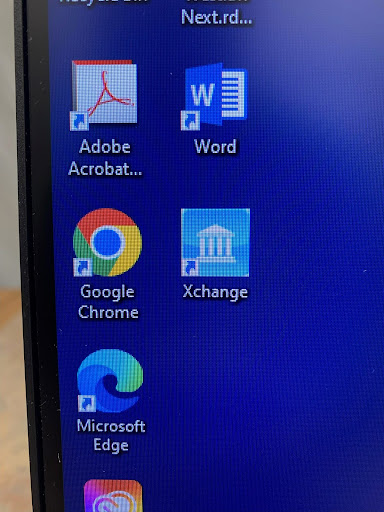
When you click the icon, login credentials will need to be entered in so that you can log in, and you’ll need to ask an employee at the Reference Desk to log you in. Reference hours are listed here so that you know when a good time to come into the library is.
Patrons can call their local Utah state district court buildings to see if they have a Public Access Xchange Terminal. The law library at the University of Utah has free access, as well as the Matheson Courthouse in Salt Lake City.
The BYU Law Library can be a little tricky finding some books because we have many library collections within the three floors of the BYU Law Library. Each collection has the books listed alphabetically and then numerically, so once you are in the correct collection, it is fairly simple to find the book you need. Getting to the correct collection could be more difficult. Follow these steps to help you find your book:
Step 1: Find the book listed on our law library website. Go to the law library’s main search bar at lawlibrary.byu.edu to search for the book. (This is our library “catalog.”)
Step 2: Check all the “holdings” for the book to ensure you are finding the year and edition you want. “Holdings” is the library word for all the places where this book may be held/located, as we may have multiple copies of the book, or multiple editions of the book. The holdings show up on the lefthand side when you are looking at a book in the catalog. In the screenshot example below, there are three holdings for the book, two first edition books from 2010 and one second edition book from 2019.
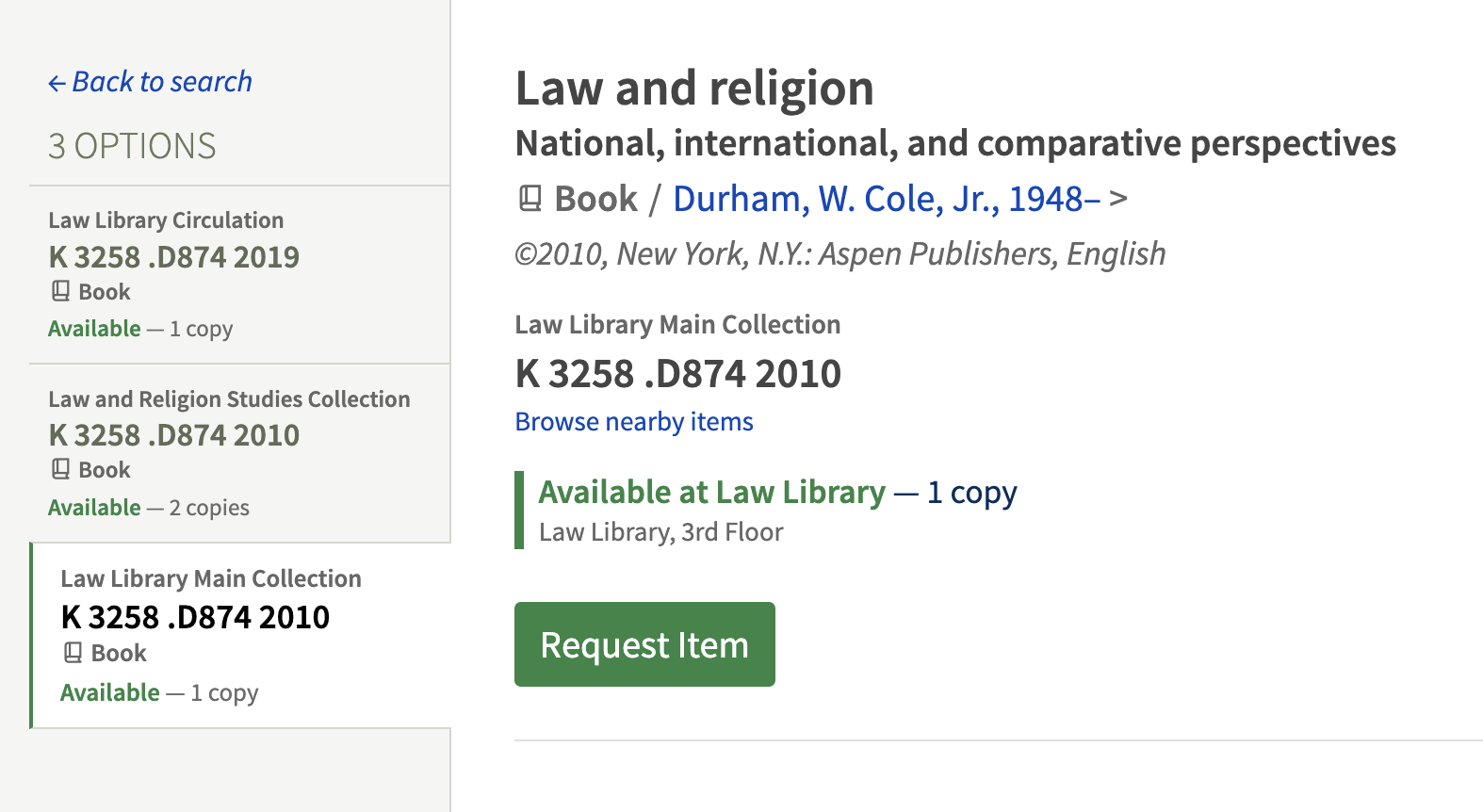
Step 3: Gather the relevant information about the book to find it more easily; simply having the call number or the title is not enough. Take a screenshot or a picture of all the information included in the screenshot above: title of the book, the author, the year it was published (Ensure you are looking at the year/edition you want for the book.) the library collection name (in gray) (This is crucial information you need!), the call number for the book (a letter and numbers in black), and where the book is available (in green) and which floor (in light gray).
In the screenshot above, the title is “Law and Religion: National, International, and Comparative Perspectives.” The author is “W. Cole Durham, Jr.” The year it was published is 2010. The library collection name is the “Law Library Main Collection.” The call number is “K 3258 .D874 2010.” The book is available at the Law Library on the 3rd floor. All this information will help you find the book more easily.
Step 4: Figure out which library collection has your book. Most of the BYU Law Library is the library collection called “Law Library Main Collection.” However, we have lots of library collections inside our library; the rest of the collections are just smaller and do not contain that many books. Some of the other library collections at the BYU Law Library that you might see listed in gray for other books include “Law Library Reserve,” “Law and Religion Studies Collection,” “Law Library Govt. Documents,” and “Law Library Self Help Collection.”
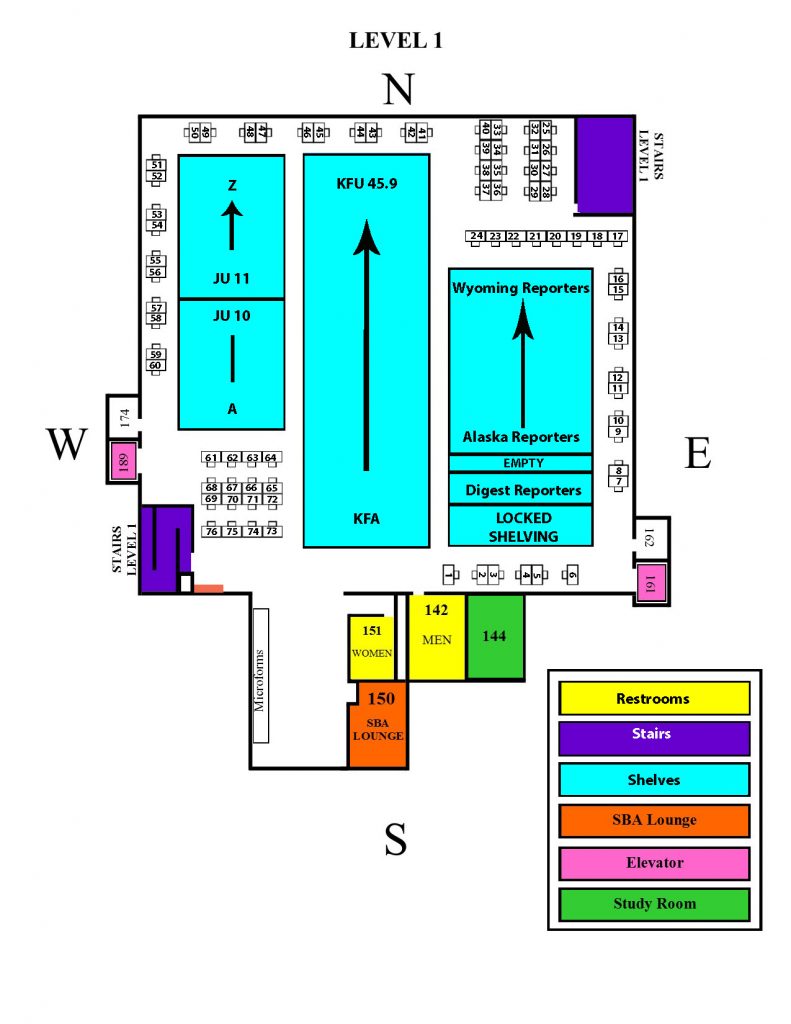
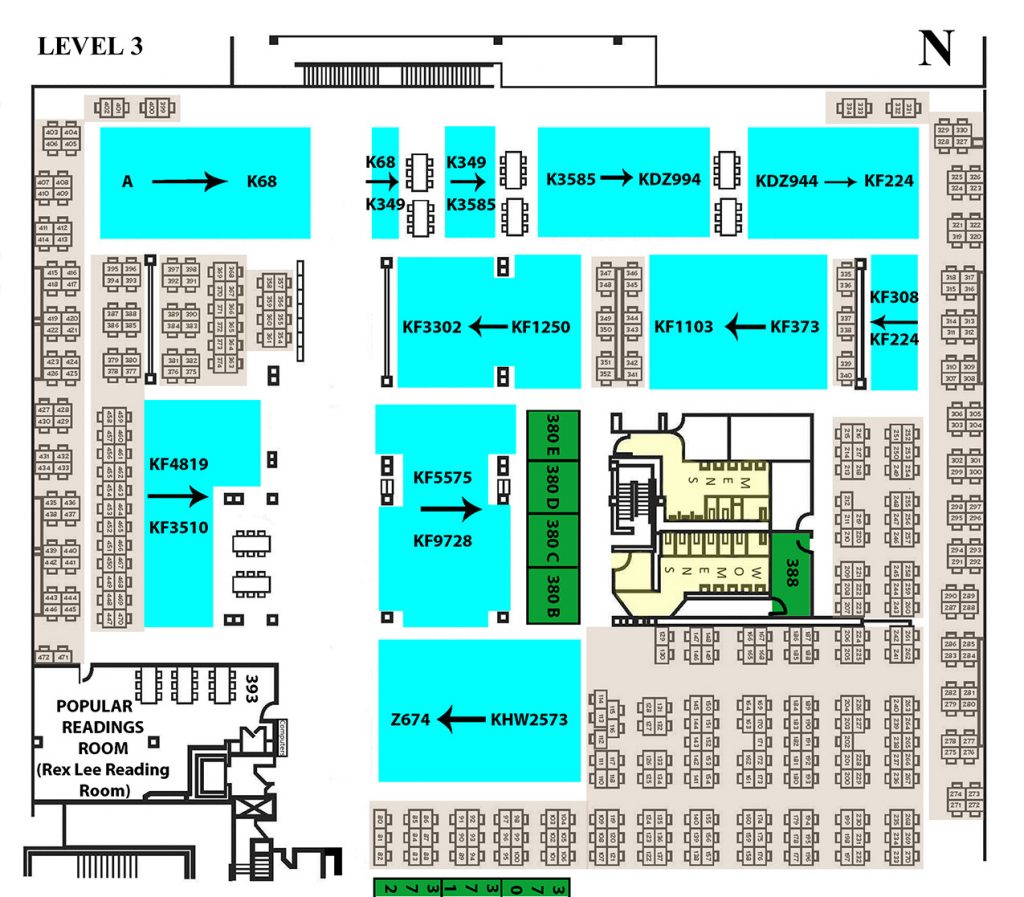
Step 5: Use the library maps. Choose the library map for the floor listed in light gray in your screenshot to find where the library collection you need is located. The library maps are linked on the law library website here. Note that the main floor / ground floor of the BYU Law Library is the second floor. The first floor is the basement. There is also a third floor of the library. Look to see where the collection is located; then go scouting. The ends of the shelves have labels to say which range of call numbers are on that aisle of shelves, and the books are all alphabetically and then numerically in order within the collection.
If your light gray listing for which floor says “Law Library, Reserve Room 2nd Floor (280 JRCB)” then the map may not list the library collection name; instead, you will go to the “Reserve Room” on the map. Once in the Reserve Room, you can look on the signs on the ends of the shelves to find the library collection you are looking for. The same is true for light gray listings for the Circulation Desk. The rest of the collections should be listed on the maps.
Step 6: You either successfully found the book (yay!), or you may need to ask a library service point, like Reference Services or the Circulation Desk for assistance. For Reference Services, you can call (801) 422-6658, email reference@law.byu.edu, or visit the physical Reference Desk on the second floor (which is the main floor of the law library) for help. A link to the book on our website is always helpful to share with them so that they have all the relevant information for finding the book. For reference hours, see here. You may also visit the Circulation Desk at the law library main entrance for help finding a book if Reference Services is not available.
Missing Books: If you cannot find the book after trying these steps and talking with a library service point employee, the book may be missing. You may follow the “Missing Books” steps on this webpage to request that a search for the missing book take place.
Note: Most call numbers for law library books begin with KF, which is the category for “law.” So any call number in the “Law Library Main Collection” before KF is in the northwest corner of the 3rd floor of the law library. Anything after KF that are in the “Law Library Main Collection” tends to be on the 1st floor (the basement floor) of the law library.
NOTE: Please contact Circulation/ILL to request any item that is unavailable.
The first floor of the library houses documents from federal and state governments, as well as selected legal periodicals. Please ask Reference for assistance in locating specific records.
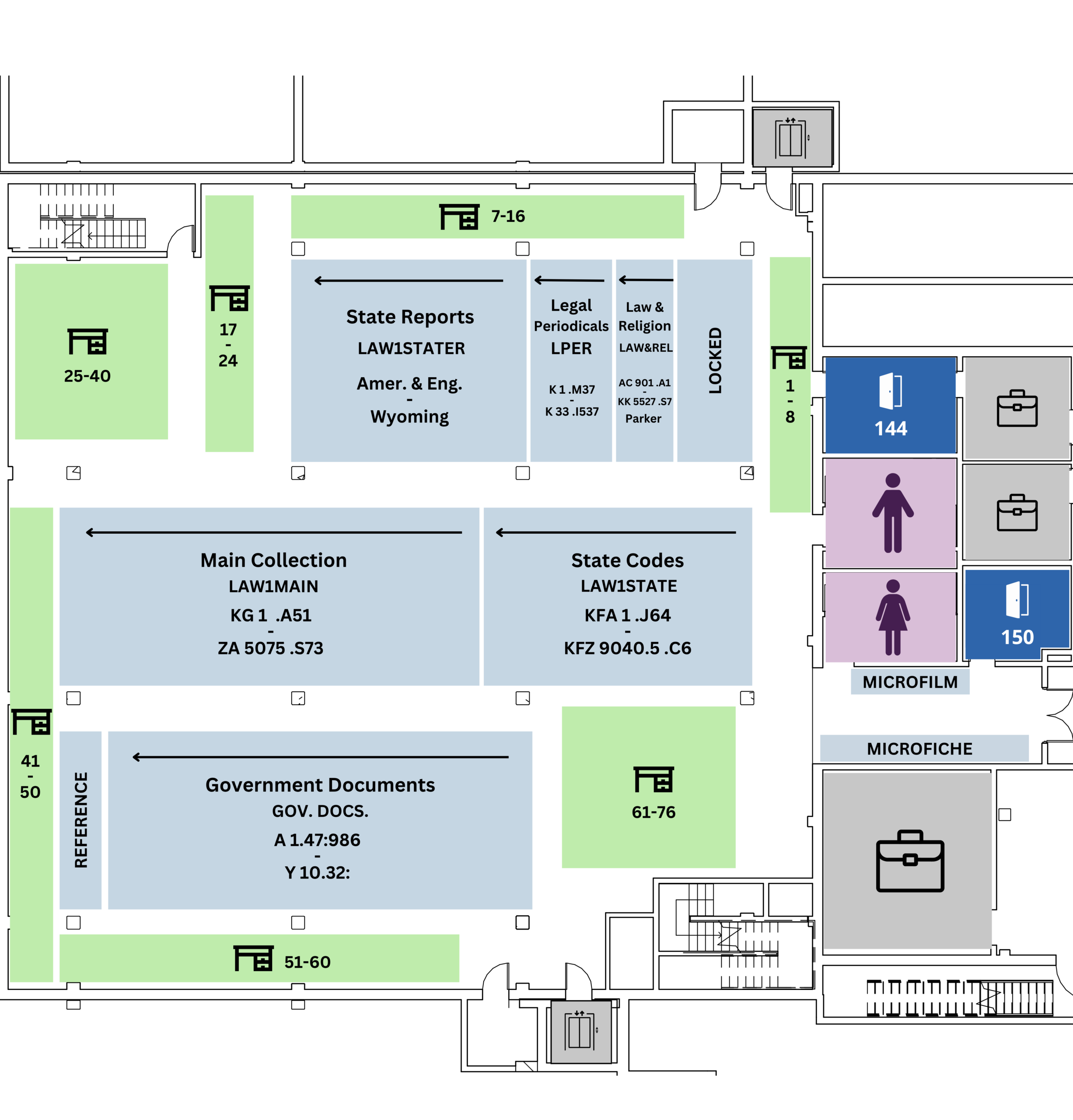
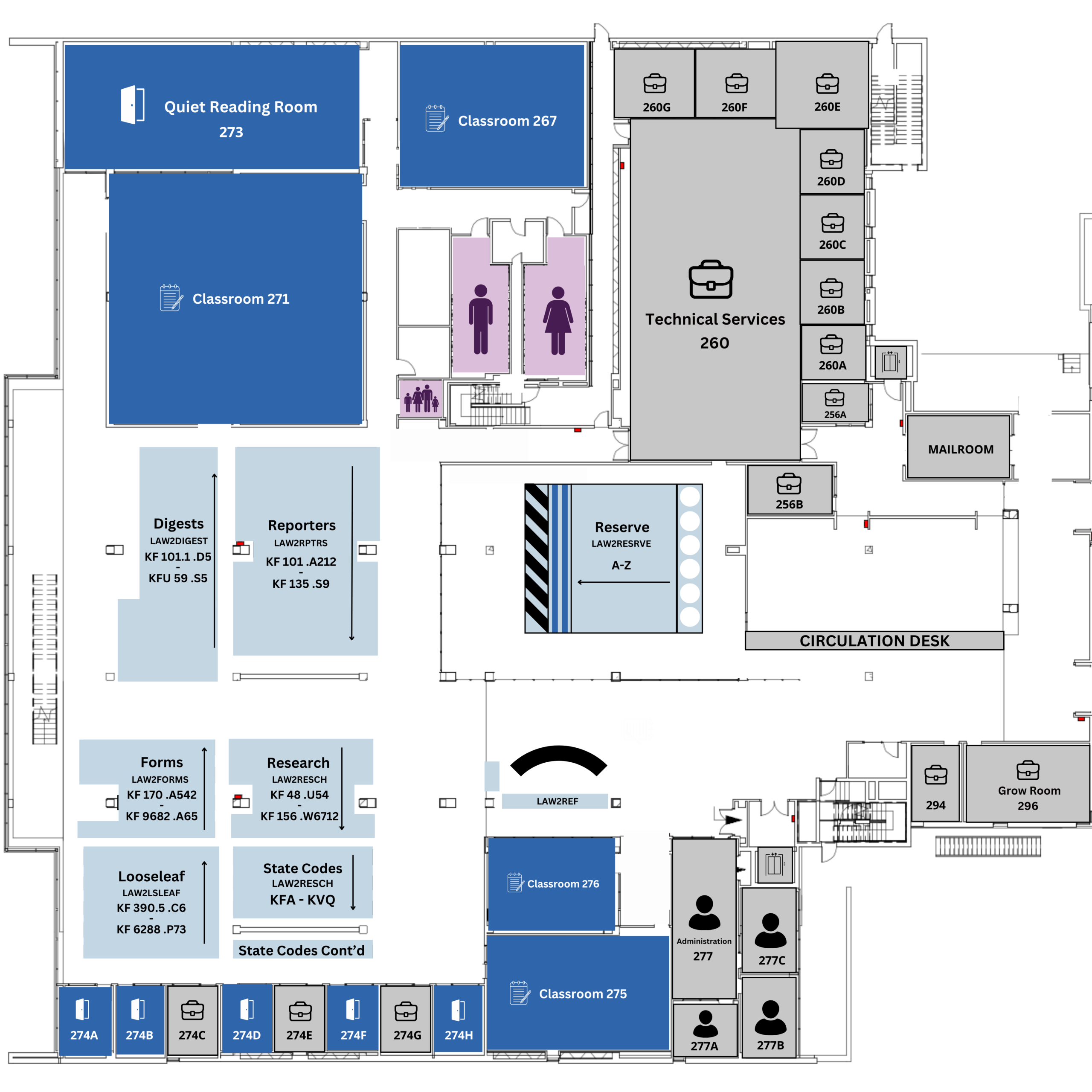
The main floor of the library contains primary legal materials generated by federal and state governments, finding aids, selected secondary resources and items on reserve. The public Westlaw and HeinOnline computers are near the reference desk. Reference Assistants, located at the desk near these resources, can provide training on the use of the available digital and print collections.
The Law Library’s circulating book collection is shelved on the third floor. This floor is also the location of most law student personal study spaces. Non-students should avoid disturbing anyone who is studying, and must not remain on this floor any longer than is necessary to locate the books needed for their research. Circulating books may be carried to the main floor of the library where public study tables are provided for non-student patrons, or checked out from the Circulation Desk (also located on the main/ground floor).
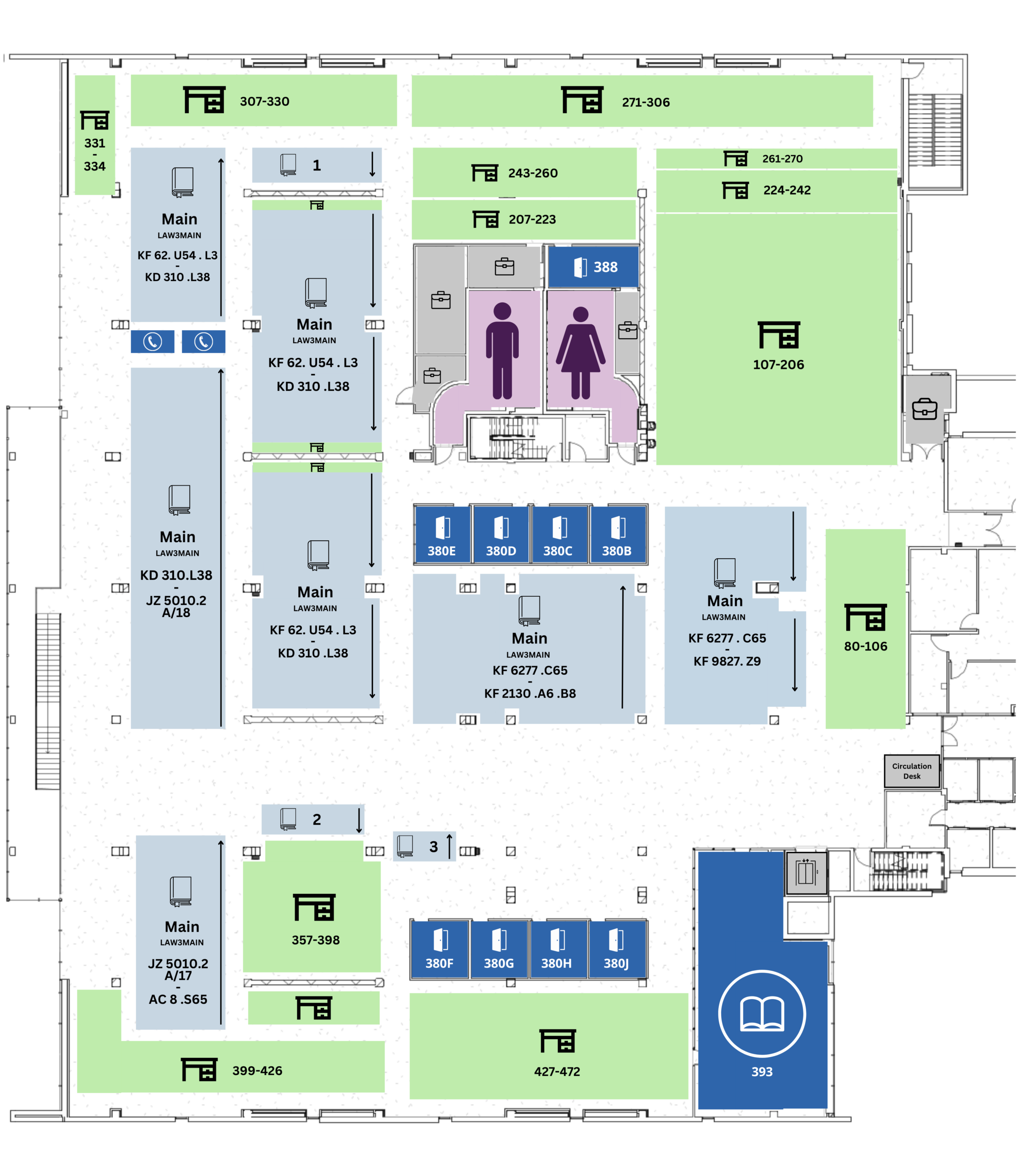
Students and faculty of Utah universities and colleges whose libraries are members of the Utah Academic Library Consortium may check materials out from the Law Library after setting up a Community Patron Account. Please contact Melanie Coleman for information on how to set up an account. Circulating items check-out for 3 weeks.
Members of the general public may not borrow materials but are welcome to use Law Library resources while on the premises. We provide scanners for patron use.
Materials located in the Rare Book Room are available to patrons from 8am-5pm, Monday through Friday. Patrons, including BYU faculty, should contact the Reference Desk for help accessing materials from the Rare Book Room. A librarian will locate the book and bring it to the patron in the Law Library Reserve Room next to the Circulation Desk. Patrons are not permitted to remove any items from the Rare Book Room from the Reserve Room. The book will be checked out to the patron during use. Patrons must return all materials from the Rare Book Room to the circulation clerk when finished.
The BYU Law Digital Repository contains open access copies of the scholarly works of Law School faculty, annual reports and other official publications, and the online archives of the various legal journals published at BYU Law.
Open-access consortia seek to make high-quality academic work available throughout the world at minimal cost to students, academics and scholars of all levels. The full archives of the BYU Law Review, BYU Journal of Public Law, BYU Education and Law Journal, and BYU International Law & Management Review are available through the Law Review Commons. Other publications such as the Clark Memorandum, Advocate (and annual reports), Life in the Law and the scholarly works published by Law School Faculty are all accessible to researchers through the more-expansive Law Commons. The Digital Commons network includes works from all areas of scholarly and academic inquiry, and contains millions of individual articles produced at hundreds of universities.
Scholarly articles and other works uploaded to the repository by BYU Law have accessed and downloaded almost 3.5 million times since the repository was established. We average over 750,000 downloads/year from over 200 countries/regions by thousands of institutions and individuals.
A map displaying readership activity
for the first 6 months of 2024. ≫
The Library has installed a limited number of legal research computers near reference for general public access. Resources such as Westlaw Patron Access and HeinOnline are available, as well as selected CCH and ProQuest Databases. Please ask a reference employee for assistance in accessing these resources.
Please be aware that we no longer have public-access printers, so results need to be saved to email or a USB drive.
The Law Library does not have any printers available for public patrons. The Law Library provides document scanners, which allow the option of saving a document as a PDF to save and print at home, for use by the BYU Law school community and for use by public patrons who are scanning library materials. If you need an on campus printing option, BYU has several Print Centers or Printer Kiosks across campus.
The Y App can help you find the closest pharos printer. The Print and Mail website provides more information about these options.
The copyright law of the United States (Title 17, U.S. Code) governs the making of photocopies or other reproductions of copyrighted material. The person using the equipment is liable for any infringement.
Please note that scanning all or even a substantial portion of a book in order to avoid purchasing a copy is not a Fair Use (see § 107(4)).
Scanned PDFs may be saved to USB flash drives, uploaded to cloud-based systems like your own Google Drive, Box, or Dropbox account, or emailed using web-based accounts such as Yahoo or Gmail.
Scanner Locations
The Law Library currently has:
Employees at the Circulation and Reference are trained and ready to assist anyone in the BYU Law community who needs help with scanning and anyone from the public who needs help scanning library materials.
Microform
Copies of documents on microform can be made as digital scans on the public computer in the Microform area (first floor). Patrons may email those scans on that computer to themselves.
The law library does not offer printing services for BYU students that are not affiliated with the law school or public patrons. Please visit the Lee Library or Cougar Creations for your printing needs.
BYU Law provides Co-Op printers for BYU Law students. To learn more about the cost, how to install it and use it, see the BYU Law page on Co-Op printing.
During Fall and Winter Semesters, the Law Library is open from 7:00am until 12:00 midnight, Monday through Thursday; 7:00am until 10:00pm on Friday; and 8:00am until 10:00pm on Saturday. The Fall Semester Schedule will begin on the first day of 1L Orientation — Wednesday of the third full week in August.
During the Spring/Summer Terms, the Law Library will be open from 8:00am until 8:00pm, Monday through Thursday; 8:00am to 6:00pm on Friday and Saturday.
The Law Library is closed on Sunday.
Holidays the Law Library is Open (9:00am until 5:00pm):
| Holidays the Law Library is Closed:
|
Upcoming Exceptions to the Schedule:
Brigham Young University Academic Calendar.
View the BYU Law School location in a larger map (get directions from Google maps).
The J. Reuben Clark Building (JRCB) is located on the east side of the BYU Campus, between the Wilkinson Student Center and 900 East, and south of Heritage Drive. Visitor parking is available just south of the JRCB. The Law Library occupies the north wing of the building.
NOTE: Please contact Circulation to request any item that is unavailable.
The first floor of the library houses documents from federal and state governments, as well as selected legal periodicals. Please ask Reference for assistance in locating specific records.
The main floor of the library contains primary legal materials generated by federal and state governments, finding aids, selected secondary resources and items on reserve. The public Westlaw and HeinOnline computers are near the reference desk. Reference Assistants, located at the desk near these resources, can provide training on the use of the available digital and print collections.
The Law Library’s circulating book collection is shelved on the third floor. This floor is also the location of most law student personal study spaces. Non-students should avoid disturbing anyone who is studying, and must not remain on this floor any longer than is necessary to locate the books needed for their research. Circulating books may be carried to the main floor of the library where public study tables are provided for non-student patrons, or checked out from the Circulation Desk (also located on the main/ground floor).
The Howard W. Hunter Law Library is open to members of the public to engage in activities associated with the use of a law library, including law-related research, reading, studying, and writing. Because the primary mission of the Law Library is to serve members of the BYU Law School community, public patrons must be conscientious of law students and faculty and carefully adhere to the policies outlined below.
To access the library after 6 pm, approved patrons will need to swipe their ID card on the reader located by the second floor – east entrance of the Law Library. Approved patrons who forget to bring their ID card and need assistance accessing the library after 6 pm, please contact the circulation desk at 801-422-3593. For questions regarding ID card access or hours, please contact Melanie Chao at chaom@law.byu.edu or 801-422-9052.
Current BYU students, faculty, administrators, or staff can use the button below to request after-hours access. Upon approval, your BYU ID card will be activated to allow swipe card access after 6 p.m. Please allow 24 hours for your request to be processed and swipe card access activated.
Eligible patrons include BYU Law School graduates, members of the Utah Bar, and UALC members. Use the button below to request after-hours access. Please allow one business day for a decision and to receive further information about after-hours access.
This category encompasses all patrons that are not eligible for a Law Community account and are not currently a BYU student/employee. Use the button below to request after-hours access. Please specify why you need after-hours access and specify why you are unable to utilize the library before 6 p.m. Each application will be considered on a case-by-case basis. Please allow 2 business days for a decision and to receive further information about after-hours access.
After-hours drop-in access is not permitted for Public Patrons.
Members of the public and BYU who are not affiliated with the Law School may research on the 2nd (main) floor of the law library. The 1st and 3rd floors are designated as BYU Law School student study areas only. Public patrons are permitted to select books on the 1st and 3rd floors, but they should only remain on these floors for short periods of time while they use the collection.
Study rooms are for law student use only.
Three computers near the reference desk are designated for use by the public for legal research purposes.
Noise should be kept to a minimum in the law library. Talking loudly or making noise that disturbs other library patrons is prohibited. Conversations should be conducted in quiet tones and in locations that do not disturb others. Cellular phones should be silenced within the library (alternative ring modes such as vibrate are permitted), and all telephone conversations should be conducted outside the library.
Food and drink is not permitted on the 2nd (main) floor of the library.
Library patrons may not engage in behavior which results in health and safety risks, property damage, or nuisance to other library users and library staff. The following are examples of behaviors not permitted in the library:
Library staff will provide a warning to users whose behavior violates library policy.* If the violator fails to heed the warning and continues violating library policy, library staff will contact University Police to remove the patron from the building. Patrons required to leave the library for policy violations may not be permitted to return to the law library.
*Serious threats to health and safety of library patrons or staff will be reported immediately to University Police without warning.
For prospective law school applicants, BYU Law School tours (which may include a tour of the BYU Law Library) may be scheduled through the Law School Admissions Department.
BYU Law Library tours for other reasons may be scheduled by contacting the BYU Law Library Administrative Assistant at (801) 422-7475.
If the catalog indicates that an item the Law Library should have has not been checked out, but it is not on the shelf, patrons can email Melanie Coleman. If the item is found, the patron will be notified by email. Missing books searches may take up to two weeks. Students may find the item quicker by checking the maroon “reshelving” shelves near where the item is usually shelved, by checking near the copy machines, and by checking on the study tables. After a student has verified that the item really is missing, it can be requested through ILL.
The Circulation Desk receives lost & found items from the J. Reuben Clark Building. These items are taken to the BYU Lost & Found Department once a month. Be aware that it often takes a few days for items to be turned in. In addition, some “finders” of lost items take them directly to the campus lost & found.
Individuals who have lost items in the JRCB are encouraged to check several times with the Circulation staff to see if the items have been turned in, and also with the BYU Lost & Found Department (1055 WSC, (801) 422-3024).
The Howard W. Hunter Law Library gratefully accepts gifts of books and other materials. Gifts are accepted with the understanding that the law library retains discretion to utilize or dispose of the items as warranted by library needs. Upon written request, at the time of donation, gifts not added to the library collection will be returned to the donor. Unless requested otherwise, a letter of acknowledgement will be sent to the donor of each gift. The library does not assign a value to gift materials. Contact Bonnie Geldmacher at 801-422-3572 for all gifts and donations.
The Law Library subscribes to dozens of online legal research tools. These resources are available off-campus only to authenticated law school users. However, most subscription resources are available within the law library for public use. Contact Reference Services for further information or for assistance with using these databases.
Foreign, Comparative, and International Law Librarian
274C JRCB | 801.422.7472

Primary Responsibilities:
Direct library operations. Facilitate faculty research and support. Oversee and maintain the library's electronic resources. Provide reference services and assistance to students, faculty and public patrons. Teach legal research.
Primary Responsibilities:
Legal reference, faculty research support and development, management of the library's electronic collections, and legal research instruction.
Primary Responsibilities:
Library maintenance, supply orders and inventory, basic support of Law Library Faculty and Staff. Schedule Law Library conference room and the Lee Reading Room.
Primary Responsibilities:
Manage the overall process of circulation and supervise the student employees. Process routed and hold materials to law school faculty and ensure law school faculty needs are being met quickly and efficiently. Process InterLibrary Loan and Document Delivery requests to meet the needs of the law school faculty, staff, and students. Processes overdue items, damaged materials, fines and the overall process of requesting materials from libraries.
Primary Responsibilities:
Oversees library marketing and outreach. Manages student study carrels, study rooms, reference computers, building security, and keys.
Primary Responsibilities:
Assist with collection organization, shelf management, and Inter-Library Loan.
Primary Responsibilities:
Oversee legal reference and faculty services, provide faculty research assistance and support, and teach legal research.
Primary Responsibilities:
Oversees legal technology trainings, law student technology certifications, and advanced technology learning platforms.
Primary Responsibilities:
Responsible for providing both general research and reference services and services for foreign, comparative, and international law inquiries. Maintains and enhances BYU Law's FCIL law collection. Teaches LLM and legal research classes.
Primary Responsibilities:
Managing the library's electronic collections, teaching legal research, providing faculty research support, and providing general legal reference services.
Primary Responsibilities:
Acquires legal materials for the law library collection. Oversees cataloging and serials, looseleaf filing, donations, and the bindery.
Primary Responsibilities:
Catalogs newly acquired print and electronic legal resources, processes old law material, and assists in paying for legal material for the Law Library.
Primary Responsibilities:
Responsible for maintaining the serials collection in the Law Library. Coordinates with other Law Library employees to process data project requests from Law School and Law Library faculty.
Primary Responsibilities:
Lead the Library and Networked Information Department (LNIS) which supports, develops, and implements information technology within the Howard W. Hunter Law Library. Coordinate support with the Law School Computing Support Department for law school enterprise-wide information technology
Primary Responsibilities:
Oversee technical aspects of the Library's electronic database collection. Maintain electronic resources to ensure they are accessible to faculty, students, and patrons of the Law Library and meet patron and institutional needs. Evaluate, implement and support programs and applications to better support the delivery of electronic information in the academic environment.
Primary Responsibilities:
Manage the Library's presence on the web; overseeing website development, the digital archive, libguides and other web-related resources.The following is a list of contacts for some of the major services provided by the Law Library. If the service you need is not listed, please contact reference or your library liaison to request assistance:
| Bindery | Bonnie Geldmacher |
| Bloomberg Passwords | Iantha Haight |
| Book Checkout and Renewal | Circulation Desk or Melanie Coleman |
| Carrels | Melanie Chao |
| Cataloging | Andrea Howard |
| CILP Service | Contact your library liaison |
| Collection Development | Kory Staheli |
| Copyright Questions & Permission Requests | BYU Copyright Licensing Office |
| Course Reserve | Melanie Coleman |
| Digitization Requests | Melanie Coleman |
| Electronic Database Training | Iantha Haight |
| Interlibrary Loan, Document Delivery, & Lee Library Requests | Melanie Coleman |
| Gifts and Donations | Bonnie Geldmacher |
| Government Documents | Reference or your library liaison |
| Group Study Rooms | Melanie Chao |
| Keys | Melanie Chao |
| Lexis Passwords | Iantha Haight |
| Library Instruction | Annalee Hickman Pierson |
| Library Policies | Shawn Nevers |
| Lost & Found | Circulation Desk |
| Microforms | Reference or your library liaison |
| Missing Books | Melanie Coleman |
| New Material Requests | Kory Staheli or your library liaison |
| Notary Requests | Melanie Coleman, Maureen Holman or Bonnie Geldmacher |
| Overdues/Fines | Melanie Coleman |
| Preservation/Book Repair | Bonnie Geldmacher |
| Reference Questions | Reference or any Reference Librarian |
| Routing Material | Teresa Odam |
| Security | Melanie Chao |
| Website Feedback | Library Webmaster |
| Westlaw Passwords | Iantha Haight |
For more information about employees, see the Library Directory.
Group study rooms are for the exclusive use of BYU law students. Study rooms are available for students to reserve for up to two hour blocks. You can find the online reservation system and study room policies here.
Step by step directions to using the online reservation system are as follows:
Go here
Yes, the Howard W. Hunter Law Library is open to members of the public needing to conduct legal research. Members of the public may use law library materials on-site and have access to certain electronic resources through 3 computer terminals on the main floor that are reserved for legal research. Members of the public may also access BYU’s wireless guest network within the law library. BYU Law School alumni and members of the Bar may borrow law library materials that circulate.
Members of the public needing reference assistance should visit this page to see the hours that reference services are offered. Reference employees cannot give legal advice.
During Fall and Winter Semesters, the Law Library is open from 7:00am until 12:00 midnight, Monday through Thursday; 7:00am until 10:00pm on Friday; and 9:00am until 10:00pm on Saturday. The Fall Semester Schedule begins on the first day of 1L Orientation — Wednesday of the third full week in August.
For Spring/Summer, the Law Library is open from 8:00am until 8:00pm, Monday through Friday and 10:00am until 6pm on Saturday. The Spring/Summer Schedule begins on the first day of Spring term classes.
The Law Library is closed on Sunday.
Holidays the Law Library is Open (8:00 am until 5:00pm):
Holidays the Law Library is Closed:
Other Exceptions to the Schedule:
For More Info / Source(s) (Links open in new window.)
The current Reference Desk hours are available here. Call the Reference Desk at (801) 422-6658 to inquire about future Reference Desk hours.
More FAQs
You may email us your reference question at reference@law.byu.edu. BYU Law faculty and BYU Law students will receive first priority for responses, and we strive to respond by the same business day. For public patrons, we will attempt to answer reference questions within two business days, and we remind you that we cannot offer legal advice; we can provide answers to brief, factual research questions
The hours that reference services generally are available via email are listed here.
The physical Reference Desk is located on the main floor of the Law Library, and reference services are also offered virtually. See the hours for Reference Services here. Reference services are provided by both full-time law library faculty members and part-time law student reference assistants. If you need a full-time library faculty member’s assistance, you should make an appointment to guarantee their availability by emailing reference@law.byu.edu. Simply state in the email that you would like an appointment with a librarian, what your research question is, what your research question is for (which class, internship, job, etc.), and a few times (between 9am and 5pm Monday through Friday) that would work for you to have the appointment.
Additionally, many virtual reference options (like emailing, submitting a reference question, and calling) are available to both the BYU Law community and other BYU and community patrons to receive reference services. The hours that virtual reference services generally are available via the reference department are listed here.
Patrons may use the Contact Us form to submit reference questions. We will attempt to answer reference questions within two business days. We remind you that we cannot offer legal advice. We can provide answers to brief, factual research questions
To receive reference services by talking with a reference employee over the phone, call 801-422-6658. The hours that reference services generally are available via calling are listed here. If a reference employee does not answer, feel free to leave a voicemail because it is checked regularly. You may also email us your reference question at reference@law.byu.edu. The option to text a librarian is no longer available at BYU.
Members of the public are welcome to use the library and its resources on the second (main) floor of the library. Materials can be retrieved from the first and third floors, but tables, study rooms, Zoom booths, and carrels on these floors are restricted to current law students, faculty, and staff.
Thank-you for submitting your request/comment.
The appropriate library department should respond to you within a couple of days. Feel free to contact hunterlawlibrary@law.byu.edu if you don’t hear back after 3 working days.
BYU Law Faculty/Students – please reach out to Reference directly for quick research help.
The BYU Law Library has limited space and access to library materials during construction this summer in 2024 and will be locked and closed to the public beginning April 29, 2024, until further notice (likely until fall semester begins).
BYU Law Students: Please see your email for instructions on how to access the library and study carrels.
People outside the BYU Law Community, including non-law BYU students and faculty, attorneys, and local community patrons may request an exception for access to use our library materials. A request for access can be made using this form. Note that requesting access does not guarantee you access, and requests will only be granted for access to use our specialized library materials. Access for any other reason will not be granted (e.g. space to study and work, etc.). A decision regarding your request may take up to a full business day. Access, if granted, will always be brief, limited, and short-term (less than 2 hours) and will require an appointment made with a Reference Services employee to enter the library to use the access you’ve been granted.
For access to physical materials that are located on the 2nd floor, access will not be immediate.